Design for Manufacturing / Ribs and Stiffeners
DfM Deep Dive
Ribs and stiffeners: stiffness from shape, not from mass
Plastic has an E-modulus that is roughly a factor of 30 to 100 lower than steel. Thick molding is not the answer: that costs quadratically more cooling time and is more likely to show sink marks. Bending stiffness scales with the third power of the construction height, so a bit of shape does more than a lot of mass.
A large, flat, unsupported surface is the worst possible plastic shape: flimsy in use and sensitive to warpage out of the mold. Ribs are the classic answer, provided they are properly dimensioned for the wall thickness.
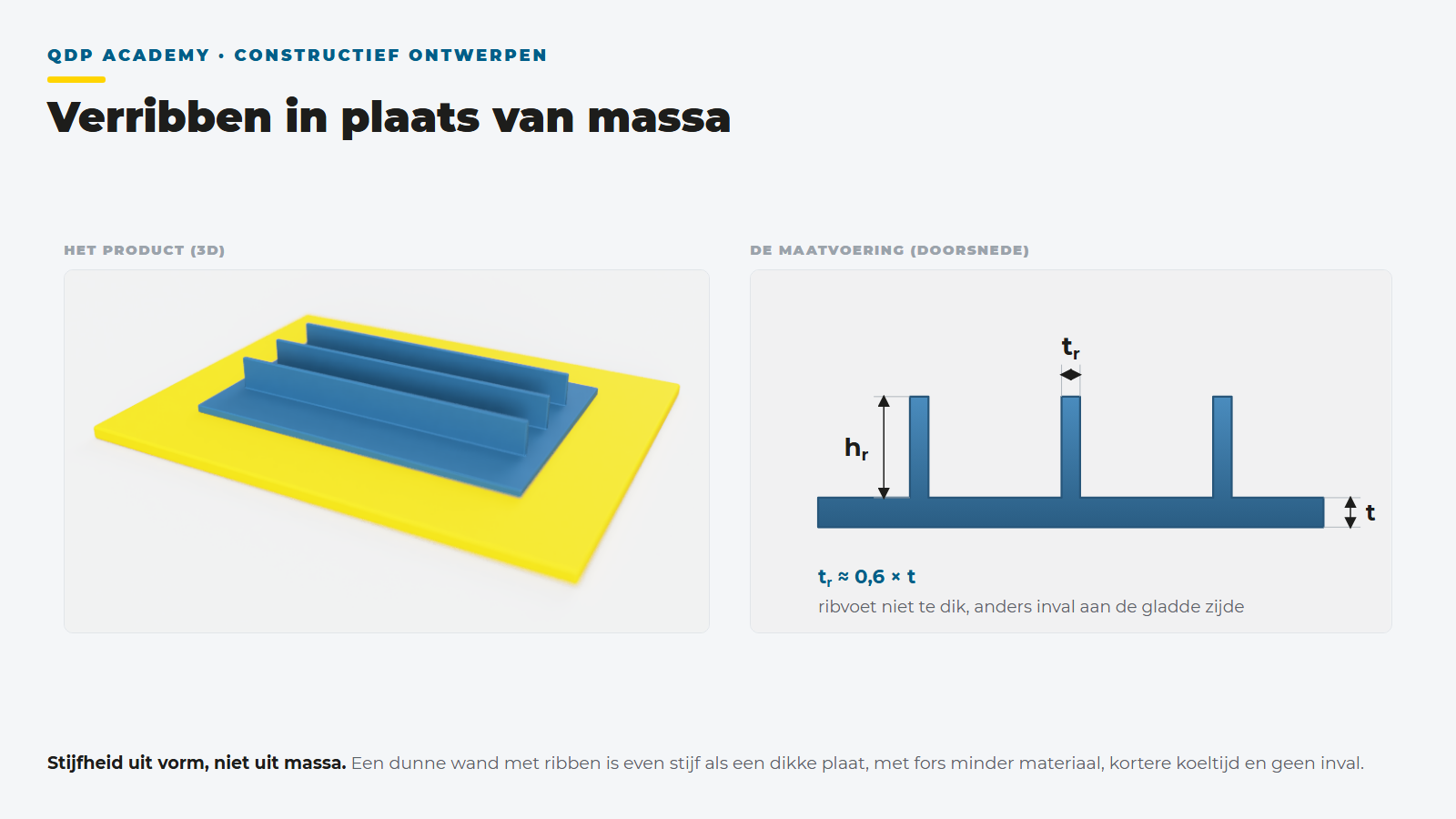
Rules of thumb for ribs
| Feature | Indicative rule |
|---|---|
| Rib base thickness | 0.4 to 0.6 x wall thickness |
| Rib height | Maximum 3x wall thickness (higher: better two lower ribs) |
| Distance between ribs | At least 2x wall thickness |
| Rib base radius | 0.25 to 0.5 x wall thickness |
| Draft on rib flanks | 0.5 to 1 degree per side |
The toolkit for stiffness
In addition to ribs, there are more ways to achieve stiffness from shape. Crowning (a slight curvature of a few millimeters on a large surface) makes a surface dramatically stiffer and hides warpage. Turned edges (a 90-degree flange around a lid or panel) act as an edge beam, often more effective than a field full of ribs. Hollow profiles provide torsional stiffness where separate ribs do not.
First the edge, then the field: a stiff edge construction around the product provides more stiffness per gram than ribs in the middle of the surface.
Ribs are the classic cause of sink marks at the wall joint: view the full DfM-pillar or go to wall thickness.
What does this mean for your design?
Calculate your mold and unit price in 2 minutes, or ask our engineers for a DfM check.