Design for Manufacturing · We think in molds
Design for Manufacturing: designing with the mold in mind
The manufacturability of your product is determined in the design, not on the production floor. We guide those choices from the very first sketch, so your product comes out of the mold reliably, quickly, and cost-effectively.
The basics
What is Design for Manufacturing?
Design for Manufacturing (DfM) is designing a product with the production method as the starting point, so that it is manufacturable without costly modifications. For plastic injection molding this means: you don’t just draw a shape and then look for a mold, but you let the mold guide the design. Wall thickness, draft angles, parting line, ribs, and gating determine from the first sketch whether a product can be made reliably, quickly, and cost-effectively.
- What: designing with the mold in mind, from the first sketch to the series.
- Why: the largest part of your cost price is fixed in the design phase, not on the production floor.
- Yield: fewer design iterations and typically 10 to 30 percent lower unit price.
- Where it applies: wall thickness (usually 1.5 to 3 mm), draft (about 0.5 to 3 degrees per side), ribs, parting line, gating, and material choice.
- At QDP: not a separate service but the method throughout the entire process, with in-house engineering in Duiven and in-house mold construction.
The reason this is so significant: the vast majority of the final cost price is fixed in the design phase, not on the production floor. A modification that costs nothing at the drawing table costs thousands of euros in steelwork and weeks of delay after the mold is milled. Good DfM shifts the decisions to when they are still free, typically saving 10 to 30 percent on unit price.
DfM works both ways. For a new product we direct the form from the very first sketch, so you never end up with a design that later proves expensive or impossible. For an existing product, we analyze what already exists and redesign it for function, ergonomics, and manufacturability: the same or a better product, cheaper to make. That is the core of our further development and cost-down projects.
We think in molds. That's why the difference is in the design, not on the production line.
A cleverly designed product can be made more cheaply and reliably everywhere. A product that is not, stays expensive, wherever you produce it.
Where it matters
The DfM choices that determine your cost price
A handful of design choices make the biggest difference between a mold that runs smoothly and one that keeps stalling. These are the choices we steer early on.
Wall thickness
Consistent, not too thick walls prevent sink marks, shrinkage, and long cycle times. Often a wall thickness of 1.8 instead of 2.5 mm gives both material savings and faster production, without loss of stiffness.
Read more ›Draft angles
Without enough draft, a product doesn’t come out of the mold cleanly. A few degrees of draft in the design reduces drag marks, ejector damage, and rejects in the series.
Read more ›Ribs and stiffeners
Stiffness is achieved not with more material but with smart ribs. When well dimensioned, they provide strength without sink marks on the visible side and without extra weight.
Read more ›Gating and mold-flow
Where and how the material flows into the mold determines weld lines, air entrapment, and dimensional stability. We test this with mold-flow analysis before any steel is milled.
Read more ›Parting line and mold build
The parting line and number of slides directly determine the mold price. A shape that can be made with a simple two-part mold is cheaper and more reliable than one needing slides and lifters.
Read more ›Material choice
Material determines shrinkage, strength, wall thickness, and cycle time, and thus the whole mold built around it. We choose the material as part of the design, not separately.
Read more ›The process
DfM runs through our whole process
DfM is not a phase you check off, but a mindset that runs from concept to serial production.
Concept and feasibility
We immediately test your idea for manufacturability and cost order, so you know early on if and how it fits a mold.
Design and engineering
Shape, function, and ergonomics together with the DfM choices, in an integrated design ready for the mold.
Validation and mold-flow
We validate material and wall thickness and simulate filling with mold-flow analysis before any steel is milled.
Mold making
We build the mold in-house. If you purchase it, you are the owner and receive the certificate of ownership.
Serial production
Injection molding on energy-efficient machines in our own factory, with first shots we check for dimensions, surface, and shrinkage.
Optimization
Once in series, we continue to focus on unit price and quality with material optimization and cost-down projects.
Have a new idea? See how we approach it for developing a new product, or see the injection molding process.
The result
What good DfM delivers for you
Making the right choices early pays off over the whole lifespan of the product.
- Lower unit price. DfM iterations typically save 10 to 30 percent with smarter wall thickness, fewer parts, and simpler assembly.
- Shorter lead time. Fewer design iterations and mold changes, so you get to first shots faster.
- More stable quality. Less rejection and fewer surprises in the production run, since manufacturability has been calculated up front.
- Less risk. If a product is not produced as designed, you get your investment back.
From our cases
Two iF Design Awards, three lessons
The Gizmo Litter Box from GIZMO Design and the Senzatea Tea Dispenser from Senza Tea Company both won an iF Design Award 2025. Two completely different products with one approach: designed from the very first sketch for the mold in which they are made.
Test every line for manufacturability
Wall thickness, draft, gating point, and parting line are included in every design iteration, not just after the design is finished. The first concept for the litter box didn’t work in practice. After multiple designs, there was a concept of six injection-molded parts that runs in series.
Keep the chain in one hand
Design, engineering, mold flow, mold making, and serial production for both products were all with the same company. That saves handovers between agency, mold maker, and molder, and especially discussion when things might not go smoothly.
Function, use, appearance, and cost price are one equation
The tea dispenser doses loose tea with interchangeable dosing wheels from 7 to 16 cc. Earlier attempts failed because technology and aesthetics did not come together. If manufacturability is included from day one, none of those requirements need to give way.
Read the whole story in the cases: the Gizmo Litter Box and the Senzatea Tea Dispenser.
DfM in practice
"They think along with you in everything and know how to make ideas reality . A very reliable party that thinks in solutions."Read the case study
 Gijs Raaijmakers
GIZMO Design, iF Design Award 2025
Gijs Raaijmakers
GIZMO Design, iF Design Award 2025
"We wanted covers that are stronger, quieter, and more luxurious without increasing the cost price. QDP solved that with one universal injection molded housing."Read the case study
 Dennis Vroegindeweij
Owner DeVi-Group
Dennis Vroegindeweij
Owner DeVi-Group
"QDP is one of the few suppliers that can say 'yes' to these dimensions. The lines are very short, which is pleasant."Read the case study
 Carmen Smink
Van Geloven (McCain)
Carmen Smink
Van Geloven (McCain)
Try it yourself
Tweak the design, see the effect
Want to check if your design is good yourself? Adjust wall thickness, ribs, and undercuts and see instantly in the cross-section and the complexity meter what it does to manufacturability.
Cross-section of your design
Technical cross-section of product and mold. Reacts live to your settings.
The design controls
Four choices every product developer makes. Turn and watch the left side.
Why: cooling time increases roughly quadratically with wall thickness, and cooling is the largest part of the cycle.
Why: stiffness comes from geometry, not thickness. Rib base thickness 50 to 60% of the wall, height max 3x the wall.
Clashes: with lifters on, these ribs have no space: the lifter needs stroke space close to the side wall. Set the lifters to zero or move the ribs away from the side wall.
Why: an internal hook or clip requires a lifter (angled ejector): compact, but wear-sensitive and limited in stroke.
Clashes: with these ribs on, the lifter can’t move: it needs stroke space which the ribs currently take. Turn off the ribs to use the lifters.
Why: an external undercut or cross-hole needs a slide: extra costs per slide, extra maintenance, and a parting line impression on the product.
Everything above is meant to make you feel what a choice does, not to quote. Want to know what your product really costs? Calculate your mold and unit price or ask our engineers in a no-obligation brainstorm.
Reference
All rules of thumb in a row
These are the numbers our engineers check every CAD file on, built from over 25 years of designing for our own mold making and factory. With every rule, the corresponding image from the QDP Academy: product in 3D on the left, dimensions on the right. Indicative, because the exact number depends on material and geometry, but if you stray far, you’ll almost always pay for it in the mold or in series.
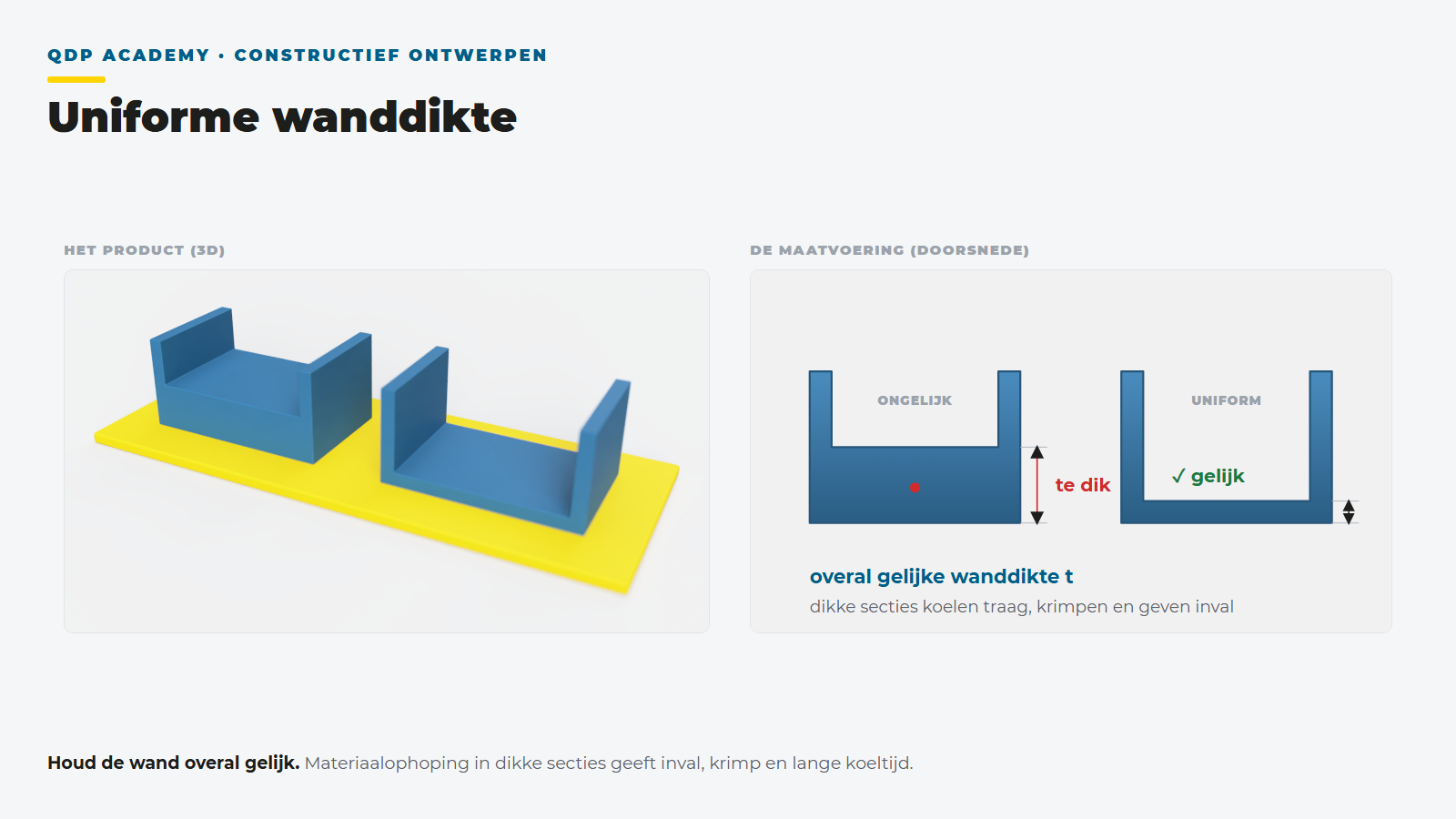
Wall thickness
Uniform, and as thin as the function permits. Most products are between 1.5 and 3 mm. Get stiffness from ribs and shape, not mass; transitions in thickness are gradual, never abrupt.
Read more ›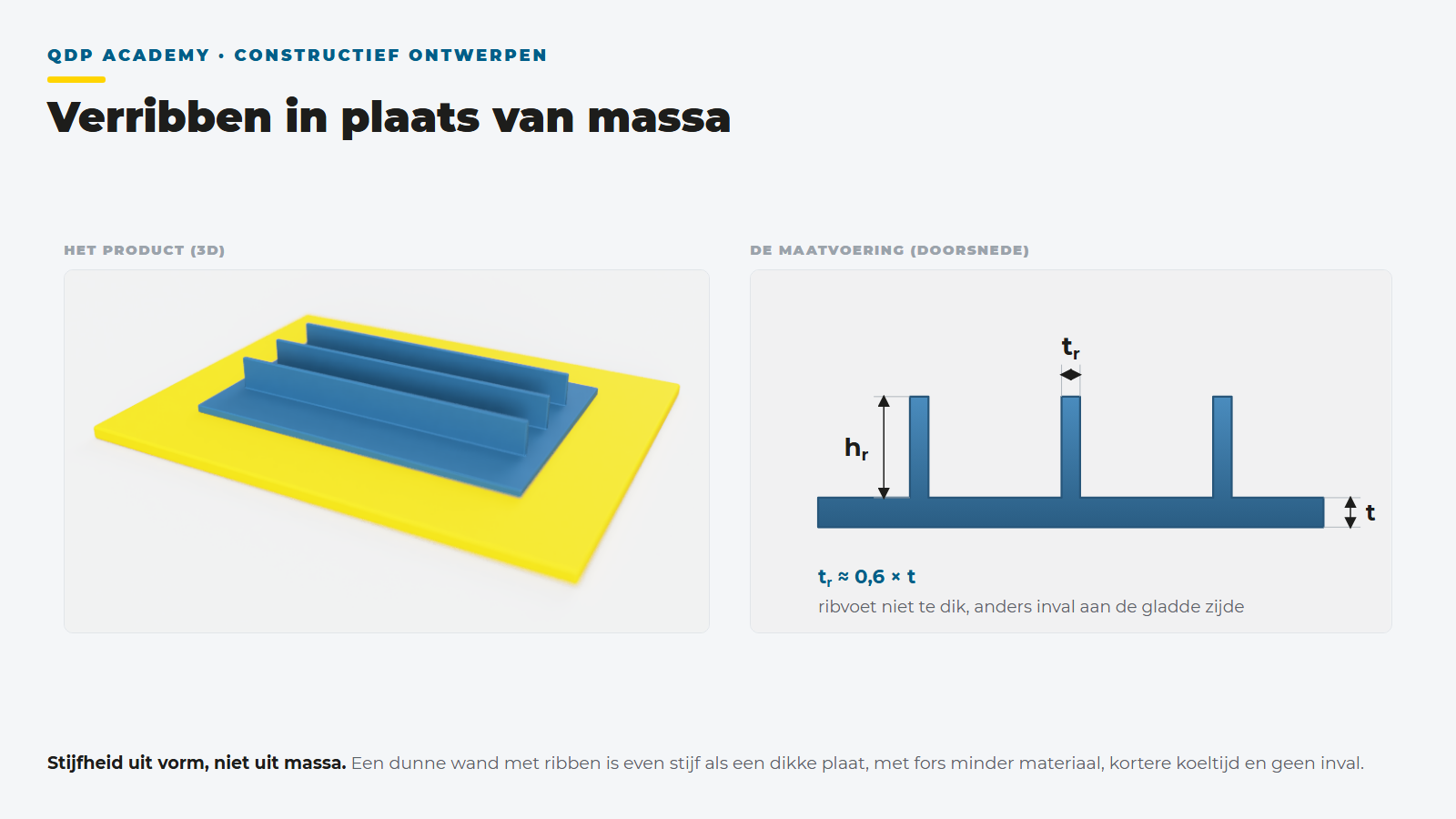
Ribs
Rib base half to sixty percent of wall thickness, then the visible side stays free from sink marks. Height up to about three times wall thickness, with draft on the flanks and a radius at the base.
Read more ›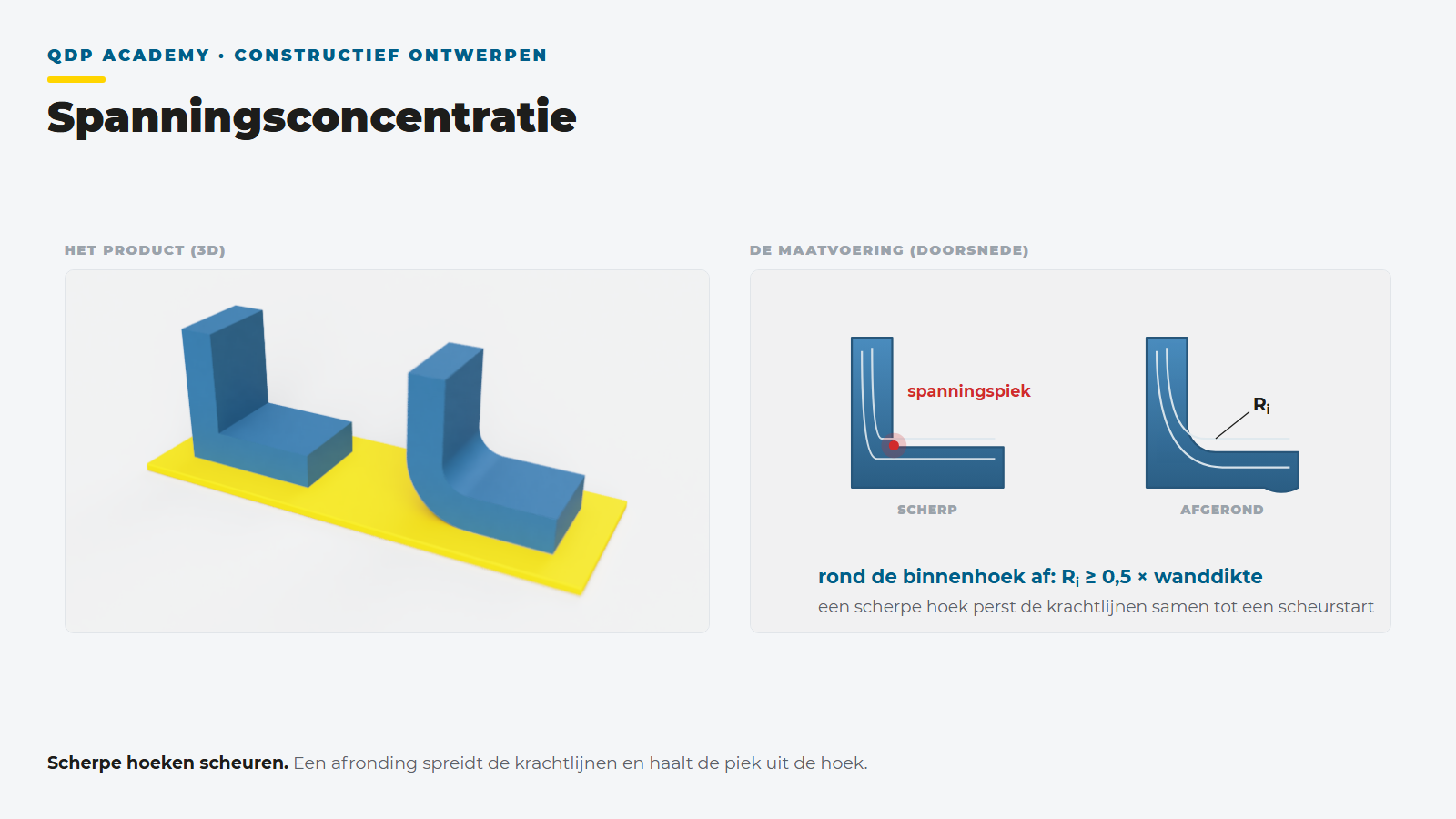
Corners and radii
Internal radius at least half wall thickness, external radius equal to internal plus wall thickness. A sharp internal corner is a stress concentration and also hinders flow in the mold.
Read more ›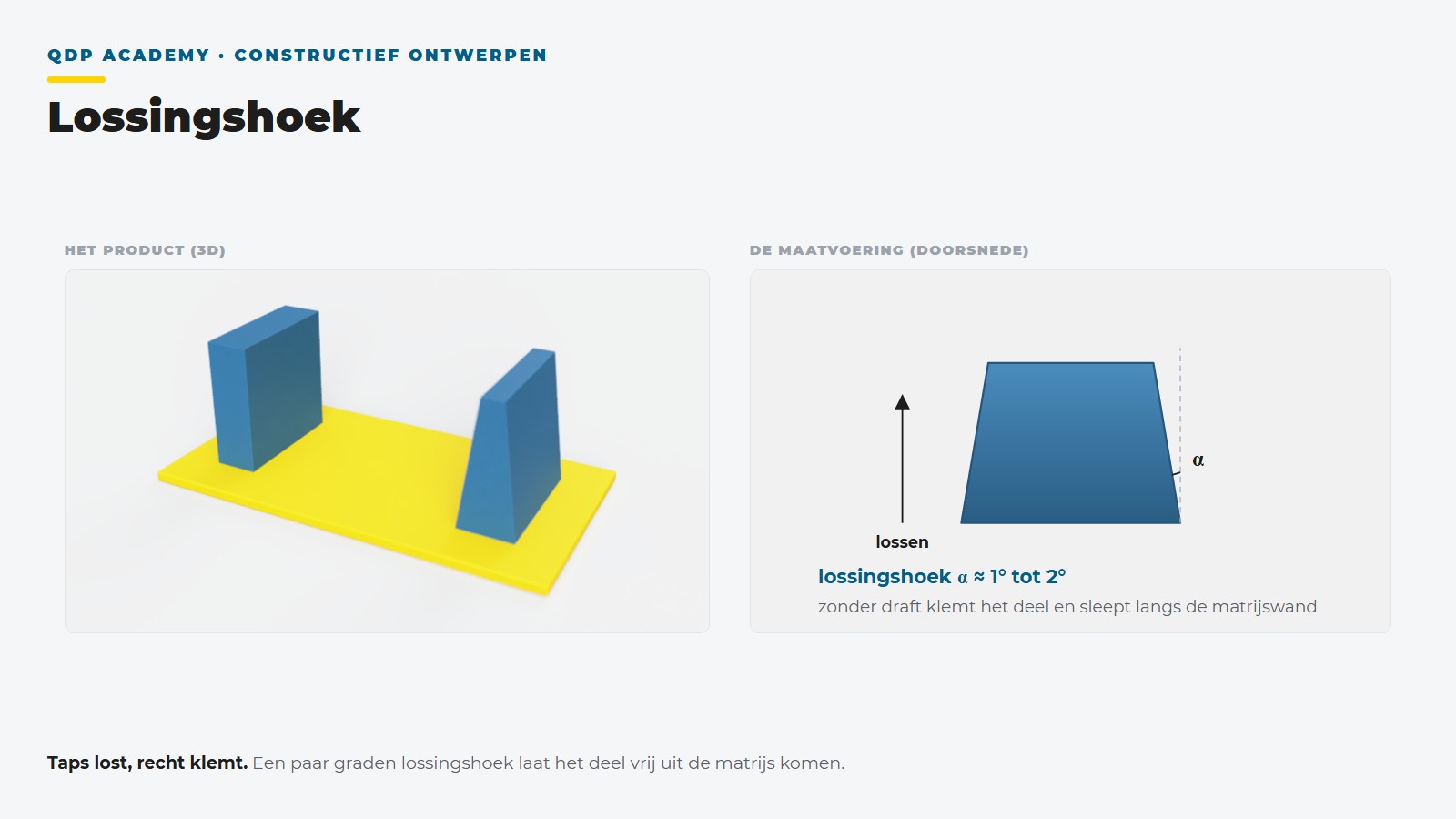
Draft angle
1 to 3 degrees on every plane in the draw direction. Structured surfaces need more: count on about 1 degree extra per 0.025 mm structure depth.
Read more ›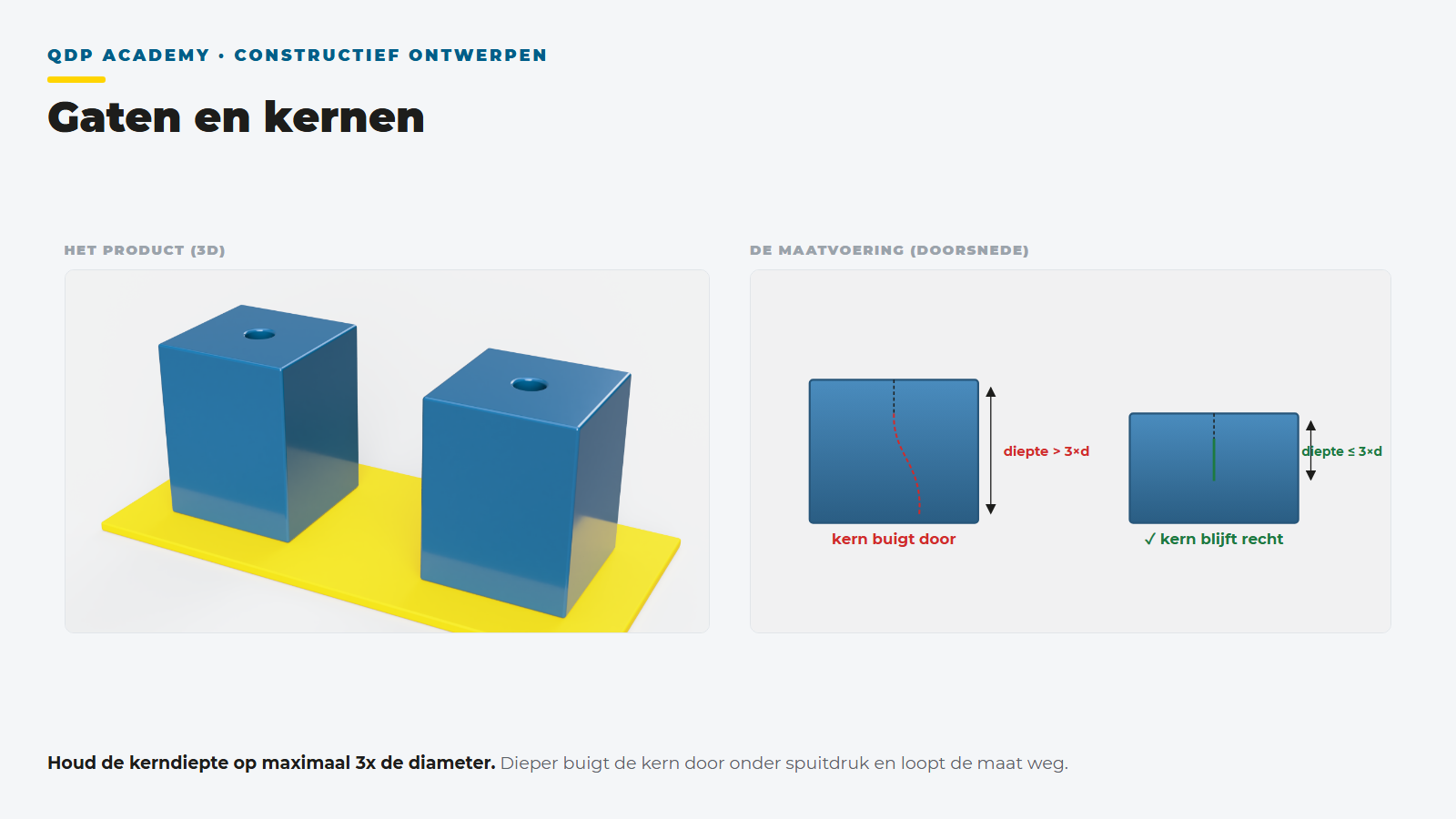
Holes and cores
A blind hole is formed by a standing core in the mold. Keep the depth at maximum three times the diameter, else the core bends under injection pressure and you lose accuracy.
Read more ›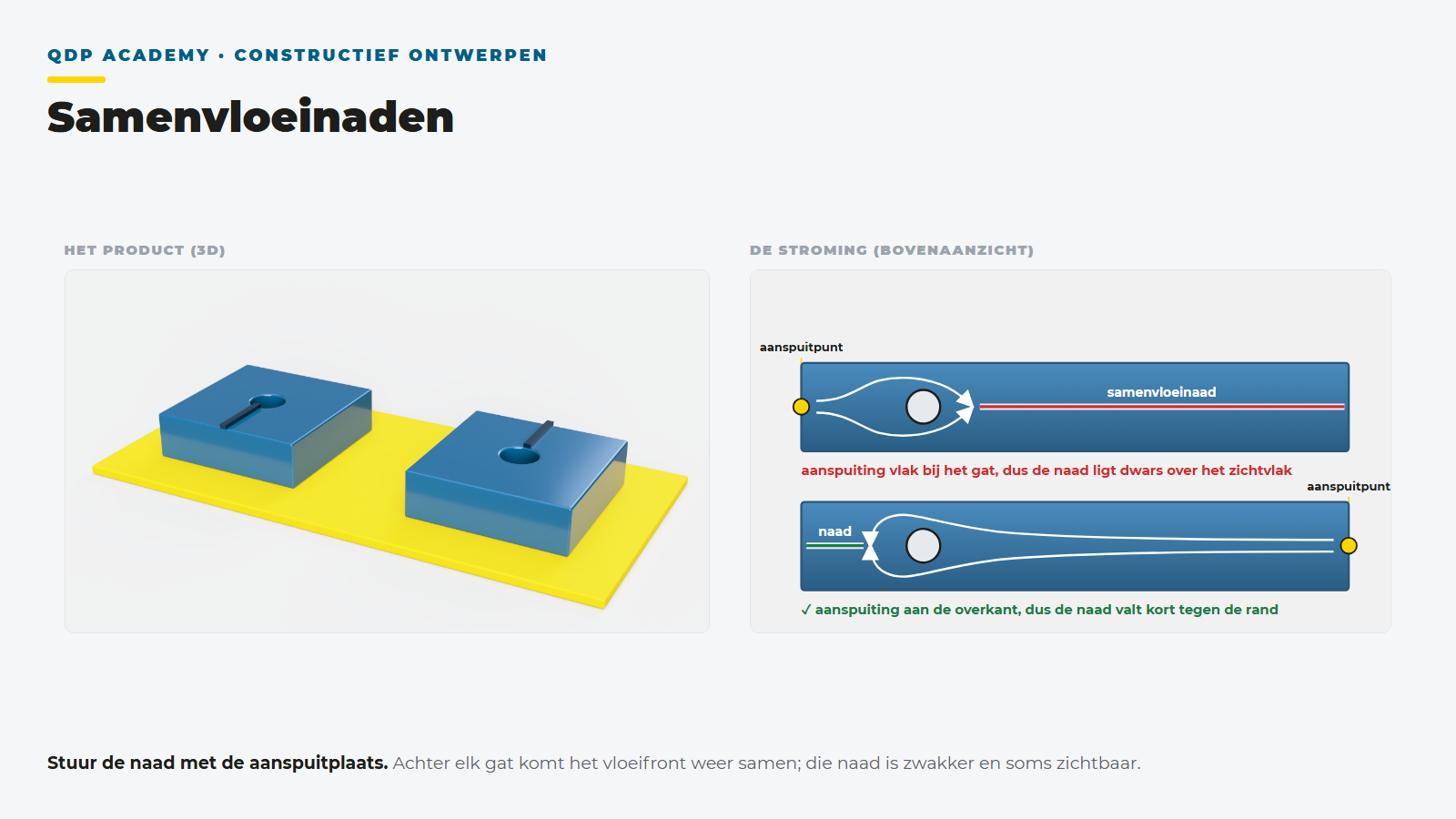
Weld lines
Behind every hole, the flow front merges again in a line that is weaker and sometimes visible. The gate location decides where that line appears, so we place it consciously.
Read more ›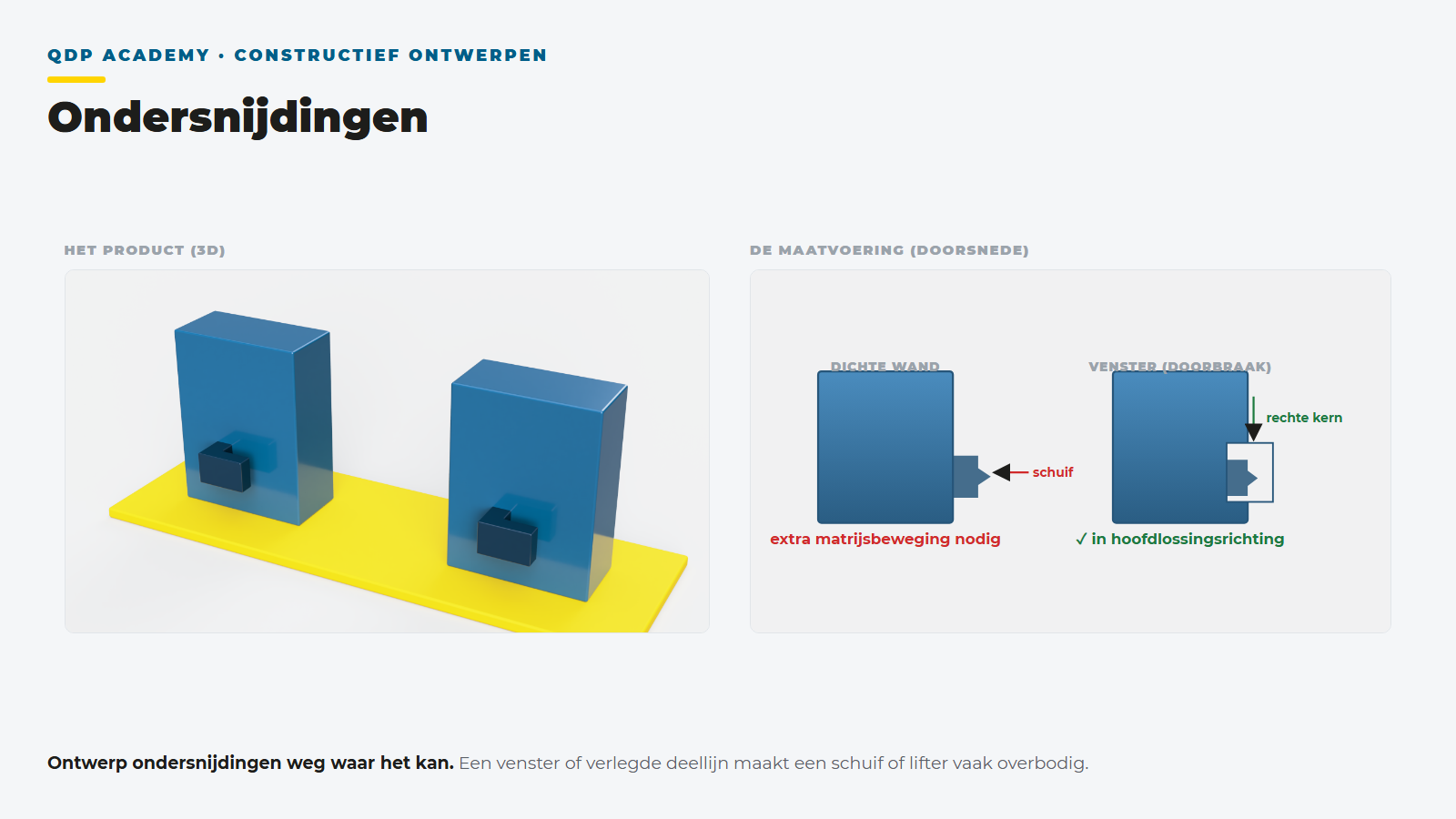
Undercuts
Every undercut needs a lifter (inside) or slide (outside) and makes the mold more expensive and fault-prone. Design them out where possible: move the parting line or create an opening, so the feature is formed in the main draw direction.
Read more ›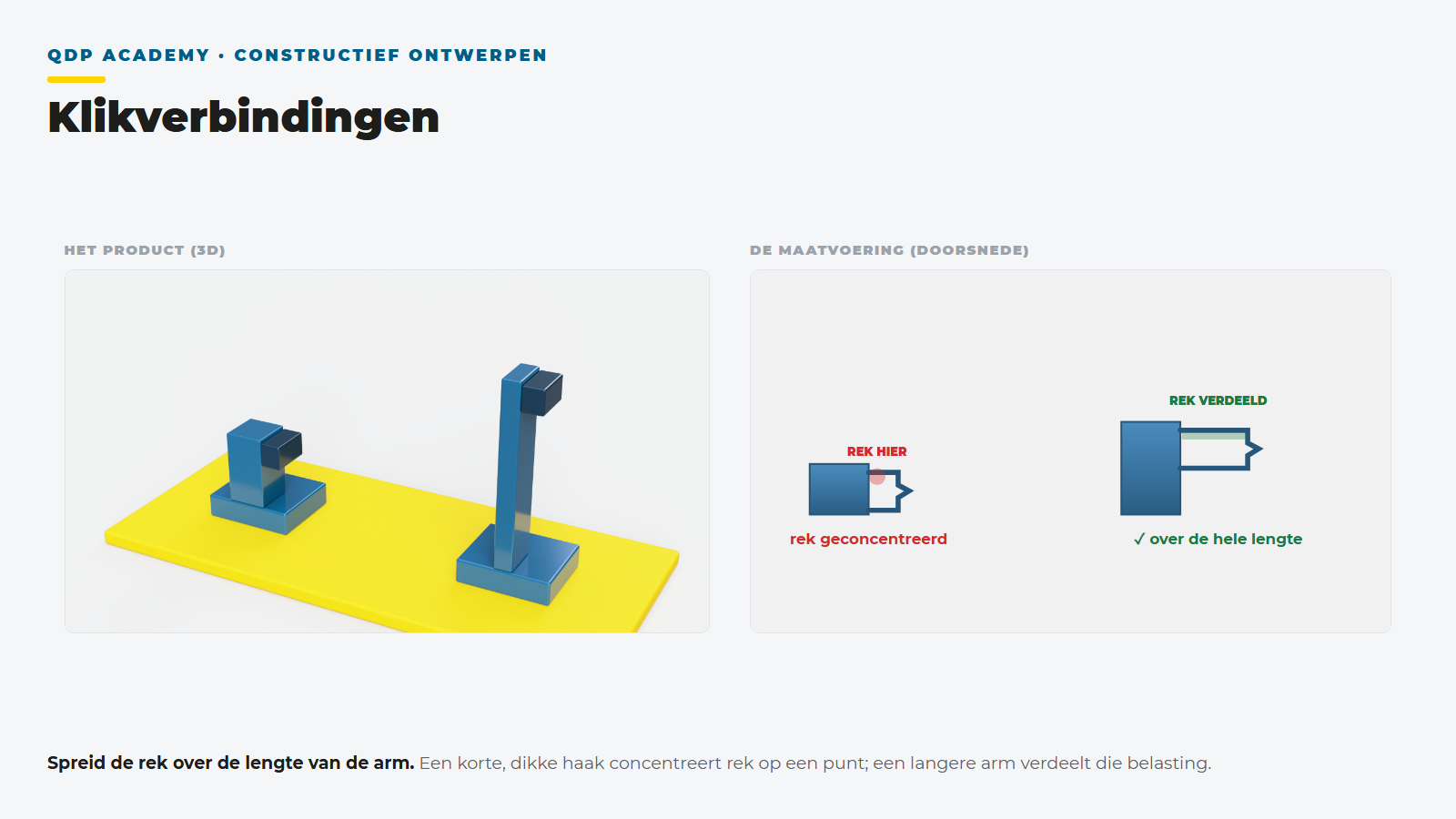
Snap fits
Keep the strain in a snap hook within what the material can repeatedly handle and distribute that strain over the length. Secure with shape, not constant preload, because plastic under constant stress relaxes.
Read more ›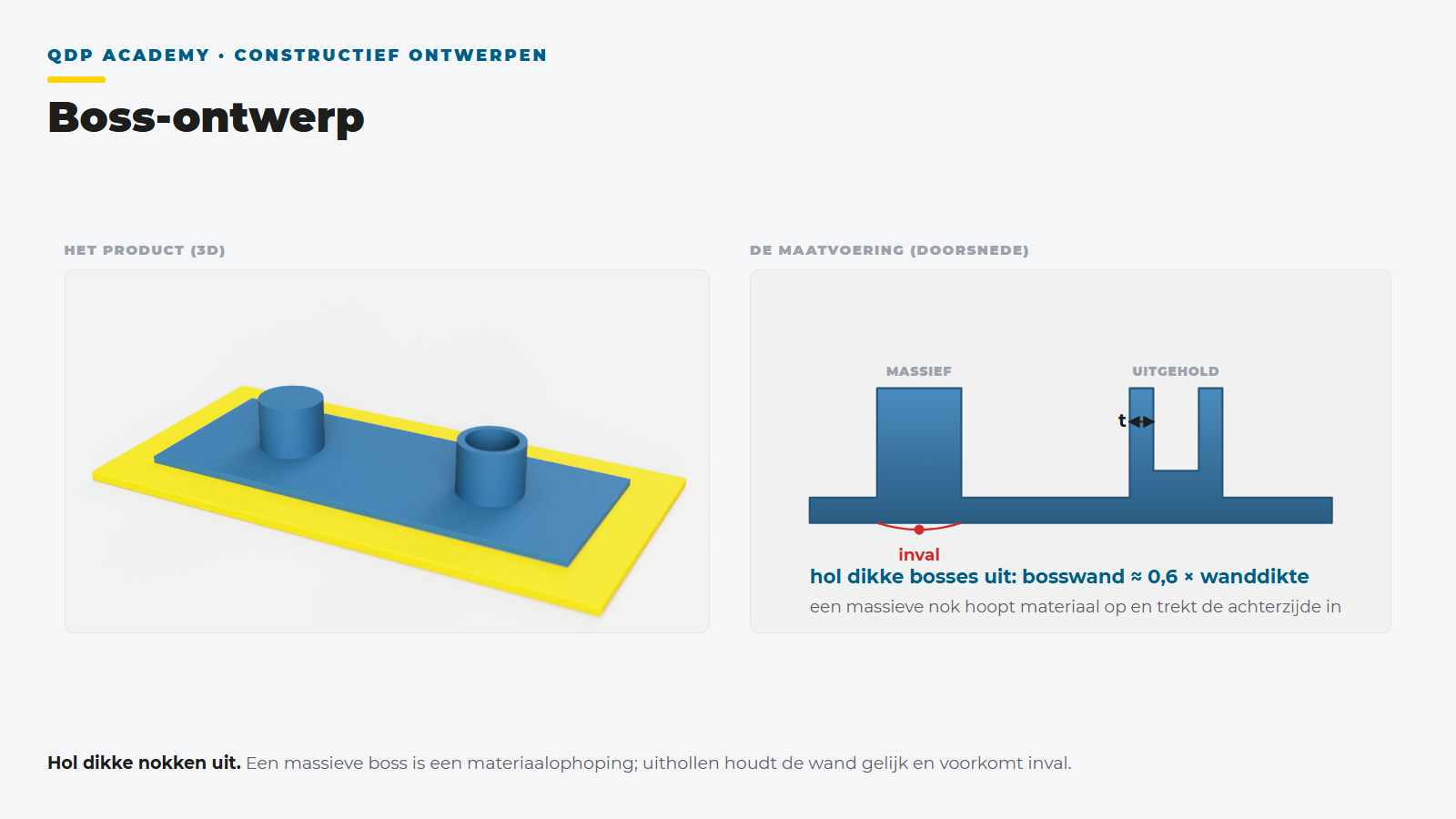
Screws and bosses
A self-tapper should go in a boss with the right ratio to wall thickness, not in solid material. Bosses that are too thick cause sink marks on the visible side: connect them to the wall with ribs instead of making them too thick.
Read more ›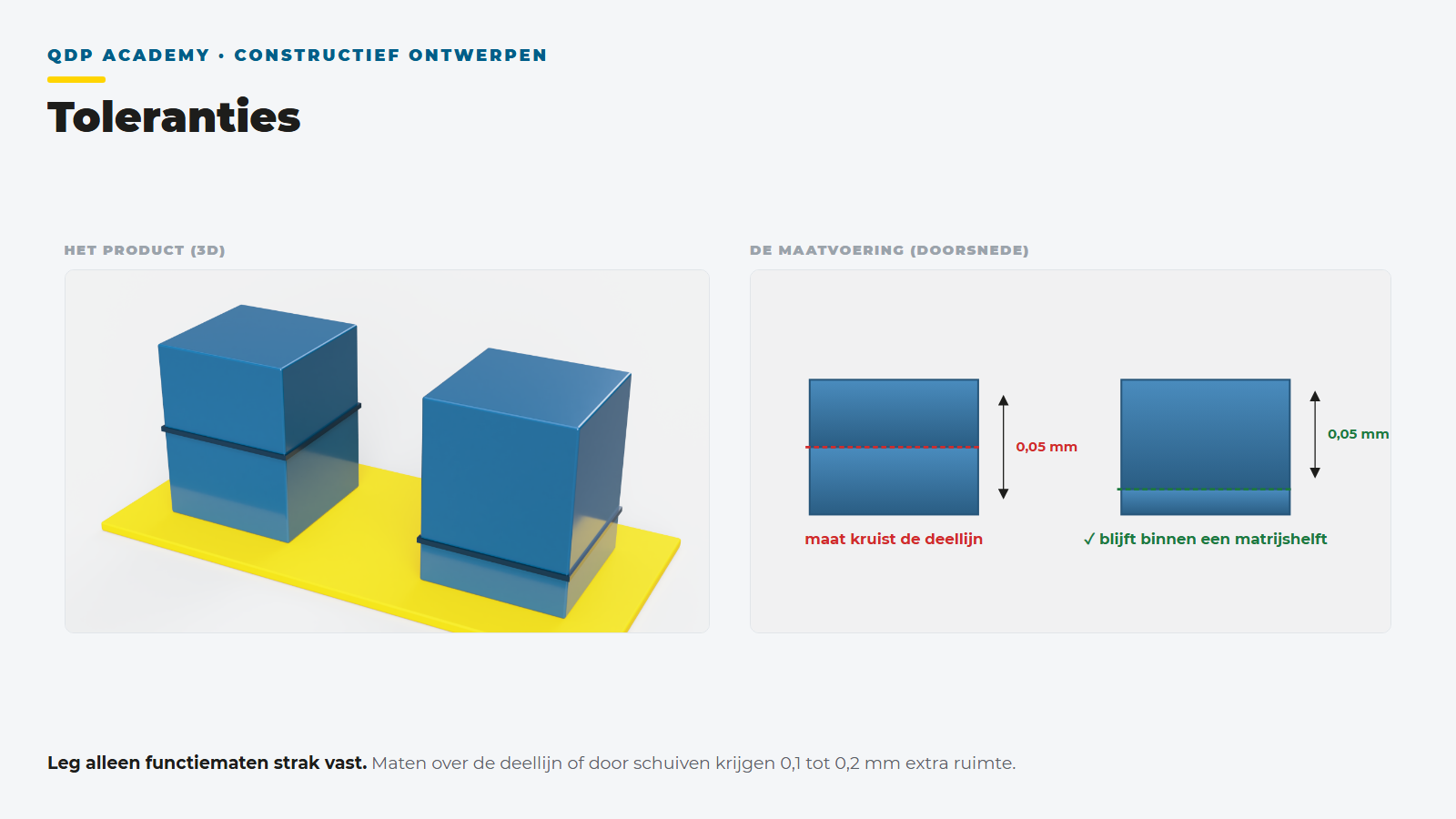
Tolerances
Set only functional dimensions tight and keep the rest general. Dimensions crossing the parting line or passing through slides get 0.1 to 0.2 mm extra tolerance on top of normal tolerance.
Read more ›Every rule above has exceptions for each material. That is why every process here starts with a DfM review: our engineers check your design against these points before any steel is ordered.
Frequently asked questions
Design for Manufacturing in brief
What exactly is Design for Manufacturing?+
Design for Manufacturing (DfM) is designing a product with the production method as the starting point. With injection molding, this means wall thickness, draft angles, ribs, gating, and material choices are included from the very first sketch, so the product can be made in the mold without costly changes. The difference with ordinary design is the order: you don’t first draw a shape and then look for a mold, but the mold guides the design. At QDP, that is the approach in every project.
Is DfM a separate service I can get separately?+
No. DfM is not a separate service but a method that runs through the entire process, from concept to serial production. A DfM check afterwards on a completed design often gives a list of modifications that require redraws. Including it from the very first sketch avoids that extra round. If you don’t have your own design capacity, QDP takes over the design via the design outsourcing service and applies DfM from day one. If you supply a design yourself, we check it before the mold is built.
When should DfM start in my project?+
As early as possible, preferably already in the concept phase. The greatest part of the cost price and manufacturability is set in the design phase, not on the production floor. A choice that costs nothing in the sketch phase, such as a slightly different wall thickness or a shifted parting line, costs thousands of euros in steelwork and weeks of delay after the mold is milled. The later DfM starts, the less can still be influenced. That’s why QDP looks in from the very first concept, even if there is no drawing yet.
What does DfM actually deliver?+
A lower unit price, fewer design iterations, and more stable quality in the series. DfM iterations typically save 10 to 30 percent on unit price by specifying smarter wall thickness, fewer components, and easier assembly. In addition, the mold is often simpler, with fewer slides, reducing investment and lead time. And because manufacturability is calculated up front, there are fewer surprises with the first shots. At QDP, the guarantee applies: if a product is not manufactured as designed, you get your investment back.
Can QDP apply DfM to an existing product?+
Yes, that is possible. For an existing product, DfM starts with an analysis of what is already there: the current design, the mold, the rejects and the assembly. Then you redesign for function, ergonomics, and manufacturability, with the aim of the same or a better product that is cheaper to make. Think of a thinner wall, merged parts, or a different material. Sometimes an adjustment to the existing mold suffices, sometimes a new one is worth it. This is the basis of QDP’s further development and cost-down projects.
What does a mold cost if I apply DfM properly?+
That depends on the size, number of cavities, and how many slides the shape needs. A single cavity mold for a simple part is cheapest, and every undercut requiring a slide makes the mold more expensive and complex. Good DfM keeps the mold as simple as possible and thus the investment lower. At QDP, a mold starts from €3,000, with a concentration between €3,000 and €5,000, and extremes up to €60,000 for large, complex jobs. You get an indication within two minutes with the calculator.
Which materials are involved in a DfM choice?+
Almost all technical plastics: ABS, PP, PA, PC, POM and glass fiber reinforced variants, plus biobased grades like PHA and PLA and recycled plastics. The material is part of the DfM consideration, not an afterthought, as it determines shrink, achievable wall thickness, cycle time and thus the entire mold around it. A mold is built for the shrinkage of one material, so switching after building costs money. QDP selects the material together with the design, based on function, environment, and cost price.
What if my product turns out not to be manufacturable?+
You reduce that risk before any steel is milled. With mold-flow analysis, you simulate filling; with material validation you check if the plastic does what the product needs, and with DfM checks you cover wall thickness, draft, and undercuts. A model to check fit is also part of it. If a detail turns out not to be manufacturable, you adjust the design while it's still cheap. At QDP, it also applies: if a product is not manufactured as designed, you get your investment back.
What wall thickness is usual for injection molding?+
Most injection molded products have a wall thickness between 1.5 and 3 mm, depending on material and flow path. More important than the number is uniformity: thick zones cool more slowly and cause sink marks, shrink holes, and warping, while zones that are too thin don’t fill completely. Stiffness comes from ribs and form, not from mass. Where a thickness difference is needed, make the transition gradual. QDP calculates wall thickness for every design based on material, flow path, and cycle time.
What tolerances are achievable in injection molding?+
That depends on material, size, and whether a dimension is in one mold half. Plastic shrinks 0.4 to 2.5 percent in the mold and that shrinkage varies per cycle. Dimensions over the parting line get 0.1 to 0.2 mm extra tolerance. Amorphous plastics such as ABS and PC shrink less and more evenly than semi-crystalline plastics like PP, PA, and POM. The rule of thumb: only set functional dimensions tightly and keep the rest general. QDP agrees on tolerances per functional dimension before building the mold.
What is a weld line and is it serious?+
A weld line occurs where two flows of molten plastic meet again, for example behind a hole. At that line, the material is slightly weaker and sometimes visible. Usually this is not a problem, but on a stressed or visible spot it is. A higher mold temperature or extra venting makes the line stronger and less visible. By consciously choosing the gating location, you determine where the line will be. QDP tests this in advance with mold-flow analysis.
How do I avoid undercuts in my design?+
Check for each detail if it can be formed in the opening direction of the mold. Often a hook, hole, or edge can be modified: move the parting line, create an opening under a snap tab, or rotate the feature a quarter turn. If not, slides or core pullers are needed. Every slide makes the mold more expensive, requires more maintenance, and may leave a visible line on the product. Therefore, check for each undercut if the function is really needed. QDP examines these details one by one with you during the DfM review.
Make your design manufacturable
Calculate your mold and unit price in 2 minutes or schedule a no-obligation brainstorm with our engineers.