Design for Manufacturing / Snap-fit Connections
DfM Deep Dive
Snap-fit Connections: the workhorse of plastic assembly
The snap-fit connection is the most intrinsic connection for plastics. No screws, no tools, no extra parts, zero assembly time. But it's also the part where most field problems come from if the strain limit, relaxation, or assembly angle is chosen incorrectly.
Three main types
| Type | Operating principle | Typical application |
|---|---|---|
| Flex snap (snap hook) | A bar with a hook bends outward and springs back behind an edge | Housing parts, covers, panels; by far the most used |
| Annular snap (ring snap) | A round edge or bead is pushed over an undercut; the whole ring stretches | Caps, pins in holes, axles, ball joints |
| Torsion snap | A torsion bar twists; the snap moves as a lever around that bar | Flaps and closures that must open with a finger press |
Allowable strain per material class (indicative)
| Material class | One-time assembly | Repeated assembly |
|---|---|---|
| Amorphous, stiff (PS, SAN) | 1 to 2% | 0.5 to 1% |
| Amorphous, tough (ABS, PC, PC/ABS) | 2 to 4% | 1 to 2% |
| Semi-crystalline (PP, PE, POM, PA dry) | 4 to 8% | 2 to 4% |
| PA conditioned (moist) | 6 to 10% | 3 to 5% |
| Glass-filled | 1 to 2% | 0.5 to 1% |
For snaps used repeatedly, calculate with about 50 to 60% of the one-time strain limit.
Self-locking or detachable
The pull-off angle on the backside of the hook determines the behavior: around 90 degrees (or slightly undercut) the snap is self-locking and only releasable by actively pressing or breaking. Between 45 and 60 degrees it is detachable with a defined pull-out force. Below 45 degrees the connection is looser and only suitable for positioning, not for load-bearing connections.
A snap secures with form, not with preload. A snap that remains permanently preloaded loses that tension due to relaxation; after months to years, the remaining clamping force can be a fraction of the initial value. Therefore, let the snap in mounted state be free of stress and ensure no rattling with a separate, soft element that may relax.
Seven practical design rules
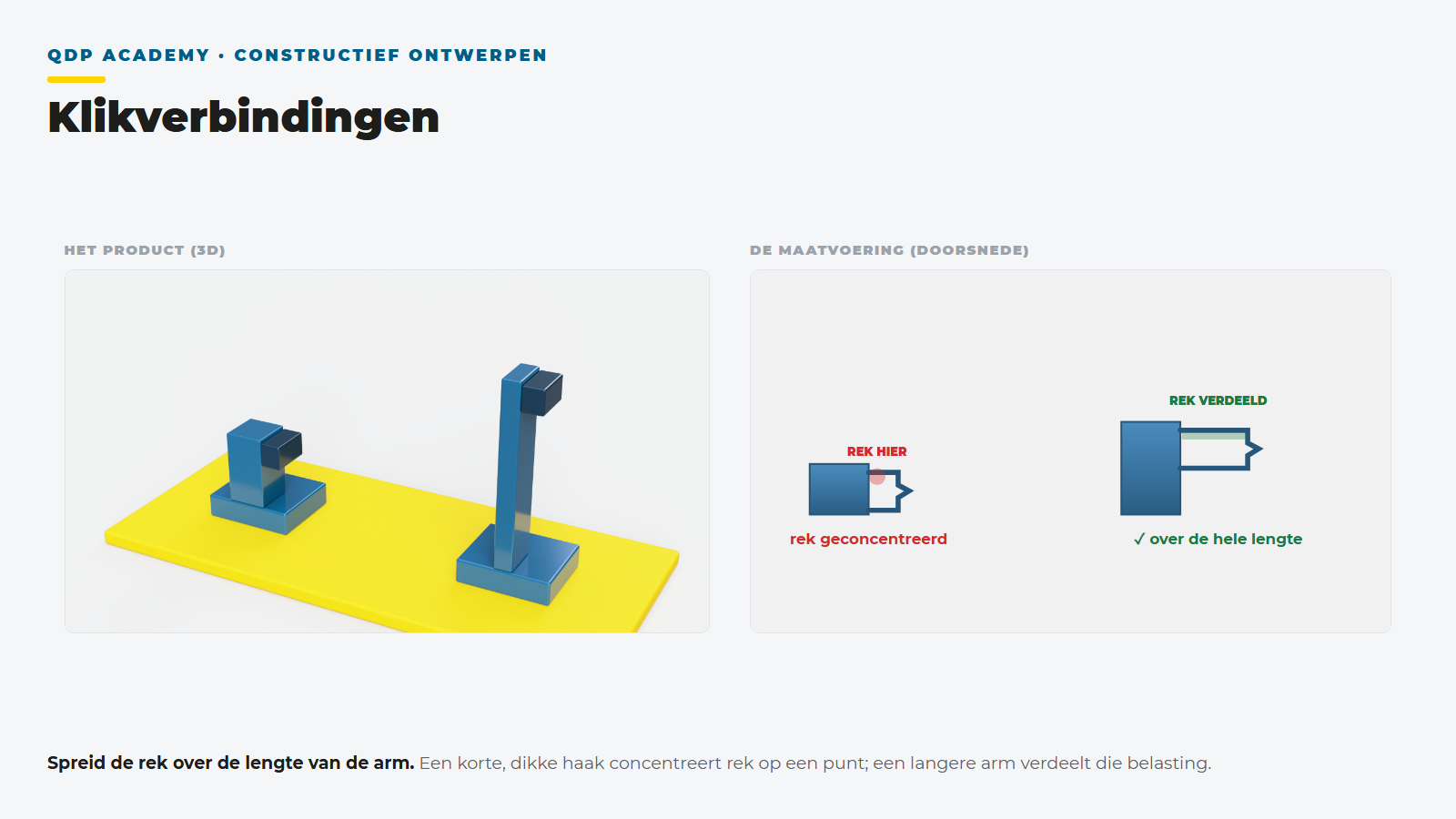
- Spread strain: taper the snap bar, thickness at the tip 50 to 70% of the base.
- Round off the base: the base of the bar is a loaded inside corner, radius at least 0.5× the wall thickness.
- Snap length: a snap of at least 5× the wall thickness is almost always feasible; shorter than 3× invites problems.
- Minimize undercut: every tenth of a millimeter extra costs strain and assembly force.
- Keep weld lines away from the snap bar; check this in mold flow.
- Deliberately design access for disassembly, or deliberately omit it.
- Make assembly direction coincide with the ejection direction where possible.
View the full DfM pillar or go to screws and studs.
What does this mean for your design?
Calculate your mold and unit price in 2 minutes, or ask our engineers for a DfM check.