Frequently Asked Questions
Answers to your questions, before you invest
QDP (Duiven, founded 1998) combines here the 54 most frequently asked questions about injection molding, molds, product development, quality, logistics and sustainability, with a link to an in-depth page per topic.
Injection Molding
About injection molding
What is plastic injection molding?+
Plastic injection molding is a production process in which molten plastic is injected under high pressure into a steel mold, cools, and comes out of the mold as a precise final product. It is the standard method to manufacture accurate plastic products in series at a low unit price. At QDP, this covers everything from design and mold to series production under one roof.
What does injection molding cost and what determines the price?+
The price consists of a one-time mold cost and the unit price. The unit price is determined by material, product weight, cycle time, and quantity; with larger series the price per piece drops. A smart design lowers both. With QDP’s online calculator you can directly calculate an indication of your unit and mold price.
How long does injection molding a new product take?+
The series production itself typically takes 3 to 4 weeks. Before that is mold manufacturing, which strongly depends on complexity, and afterwards, for production in our own factory, around 10 weeks for sea freight. Lead times are indicative and project-dependent; QDP confirms the real schedule per project based on the drawing.
Do I get quantity discounts if I order more?+
Not on the unit price itself: the injection molding process is constant, so the machine runs exactly the same cycle for 500 as for 20,000 pieces. An artificial discount tier would be robbing Peter to pay Paul. Your effective price per product does drop significantly with larger series, because the fixed costs are spread over more products: the set-up costs per production run, transport, and especially the one-time mold investment.
What is the minimum or ideal quantity for injection molding?+
Injection molding pays off as soon as the mold investment is spread over enough units. The sweet spot is between 500 and 20,000 pieces per run; smaller series are possible and we also run millions series. QDP helps you consider the quantity that fits your business case.
Can you injection mold small series?+
Yes. Small series injection molding is possible, with the sweet spot between 500 and 20,000 pieces per run, and smaller quantities where it makes sense. The key is making the one-time mold investment pay off over the series: with a simpler mold and a manufacturable design, we lower the entry, and the same mold can scale up later to larger quantities.
Which plastics can you injection mold?+
Almost all technical plastics: ABS, PP, PA, PC, POM and glass fiber reinforced variants, plus biobased grades such as PHA and PLA and recycled plastics. The material is part of the design consideration, as it determines shrinkage, strength and cycle time. QDP chooses the material based on function and practical tests.
Can injection molding be expedited?+
Yes. Rush deliveries within a week are possible because the machines, mold changes and planning are managed in-house. This is rarely possible with traditional suppliers. QDP confirms feasibility per situation.
Mold Manufacturing
About molds
What is an injection mold?+
An injection mold, also called a mold, is the steel form in which molten plastic is injected under high pressure to manufacture exact plastic products in series. The mold determines the dimensions, surface, and cycle time of your product. At QDP, the mold is designed and built in-house.
How much does it cost to have a mold made?+
A mold is a one-time investment, starting from 3,000 euros, with the main range between 3,000 and 5,000 euros and extremes up to 60,000 euros for complex large work. The price depends on complexity, number of cavities, geometry and steel selection. With QDP’s online calculator, you get an immediate indication.
Who owns the mold?+
If you purchase the mold, it truly belongs to you. You receive a certificate of ownership and are free to use it however you wish. This means you have control of your product, not the supplier. QDP always works this way, so you are never tied to one party.
How long does an injection mold last?+
A well-maintained steel mold lasts hundreds of thousands to millions of shots, depending on the steel, material, and load. Therefore, you attune the correct steel selection to your expected series size. QDP chooses the steel and number of cavities for the production lifespan suited to your product.
What is the difference between a single-cavity and multi-cavity mold?+
A single-cavity mold makes one product per shot, a multi-cavity mold several at once. Single-cavity means lower mold costs, multi-cavity a higher investment but a lower unit price with large series. The tipping point depends on your quantity; QDP calculates which option works out cheapest.
What is a mold flow analysis?+
A mold flow analysis is a simulation of how molten plastic fills the mold. You see beforehand where weld lines, air entrapment or uneven shrinkage will occur, and you adjust gating, wall thickness, or cooling before any steel is cut. QDP does this as standard, so the chance of a mistake on the first shot is virtually zero.
How long does it take to build a mold?+
The build time for a mold depends strongly on complexity, number of cavities, and geometry, so it's not a fixed number. We do work in parallel where possible: while the mold is being built, we're already prototyping. QDP confirms the actual lead time in the first conversation based on your drawing.
Is a mold the same as a die?+
Yes. Mold and die are two words for the same steel form in which a plastic product is injected. In practice, 'die' is used informally and 'mold' is used more in technical contexts. At QDP, either way you have the same in-house built injection mold made.
Product Development and DfM
About product development and DfM
What is product development?+
Product development is the process in which an idea grows into a production-ready product: from concept and industrial design, through engineering and material selection, to a manufacturable design. The goal is a product that works, fits the market, and can be made at a good cost price. At QDP, this continues through to series production under one roof.
What is Design for Manufacturing exactly?+
Design for Manufacturing (DfM) is designing a product with the production method already as the foundation. For injection molding, this means wall thickness, draft angles, ribs, gating, and material selection are incorporated from the first sketch, so the product can be made in the mold without costly modifications.
What does DfM specifically yield?+
A lower unit price, fewer design iterations and a higher, more stable quality. DfM iterations typically save 10 to 30 percent on the unit price through smarter wall thickness, fewer parts and simpler assembly.
When should DfM start in my project?+
As early as possible. The majority of your cost price and manufacturability are determined in the design phase. A DfM choice costing nothing in the sketch phase can, after milling the mold, cost thousands of euros in steelwork.
What is the difference between industrial design and product engineering?+
Industrial design is about form, use, and experience of a product, engineering is about technical elaboration: strength, material, and construction. In practice, they overlap, because a beautiful design must also be manufacturable. At QDP, design and engineering are in one team, so the two reinforce each other rather than clash.
Can QDP also just do the design?+
Yes. If you have a product and a market but no in-house design team, QDP can take care of product development for you and deliver a production-ready design. You are not obliged to also have it produced with QDP, although the real strength is design, mold, and production under one roof.
Can QDP improve or make an existing product cheaper?+
Yes. We analyze an existing product for material selection, wall thickness, and components, and redesign for function, ergonomics, and manufacturability. Cost-down projects and enhancements typically deliver 10 to 30 percent lower unit price.
Why develop and produce under one roof?+
Because every transfer between a design agency, mold maker, and injection molder costs time, money and leads to errors. Under one roof, manufacturability challenges are solved in the drawing instead of on the production line. This yields predictable quality, shorter lead times, and lower failure costs.
Quality and Warranty
About quality and warranty
Is QDP ISO 9001 certified?+
Yes. QDP is ISO 9001:2015 certified for the quality management system (by SGS, valid until May 2027), and its own factory is also SMETA 4-Pillars certified. QDP is also a member of the Koninklijke Metaalunie. View the certificate (PDF).
What is ISO 9001:2015?+
ISO 9001:2015 is the international standard for quality management. It specifies that an organization controls its processes, puts customer satisfaction at the center, and continuously improves, and that this is verified by an independent audit. QDP is ISO 9001:2015 certified, so this assurance is demonstrable and not just a promise.
What is SMETA 4-Pillars?+
SMETA is a widely used audit for responsible production. The 4-Pillars version assesses four aspects: working conditions, health and safety, environment and ethics. QDP’s own factory is audited on those four pillars, so you know under which conditions your product is made.
How does QDP ensure quality during production?+
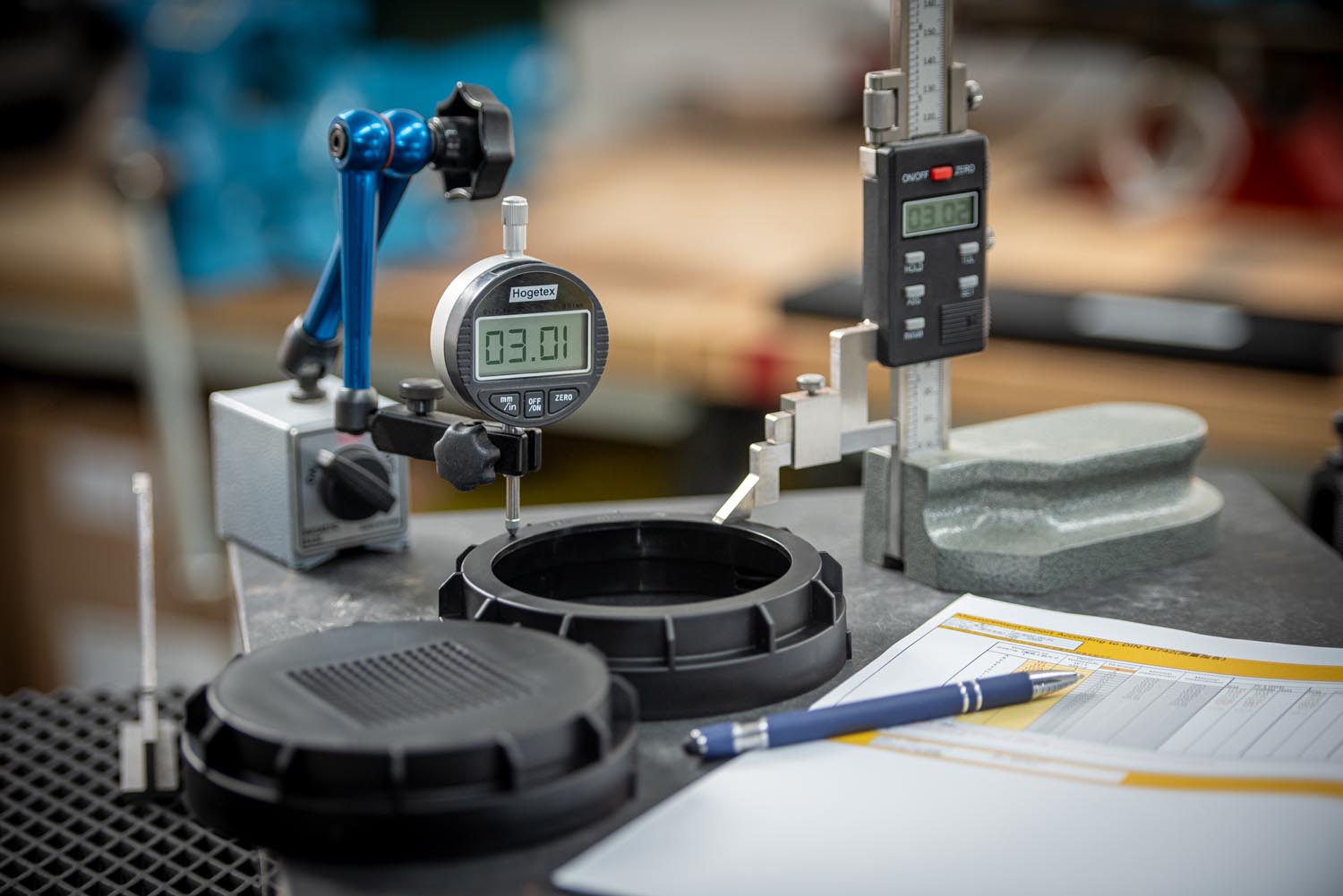
Quality is ensured in four steps: incoming inspection of raw materials, process control during production, final inspection and validation before shipping, and complete documentation and traceability. This way, the quality from the first shot is the same as the ten-thousandth, and a batch is always traceable if there are questions.
What happens if a product is not right?+
Because mold flow analysis and Design for Manufacturability happen upfront, the chance of an error is small. If a product still is not produced as designed, you get your investment back. QDP consciously keeps that risk with itself instead of the customer.
How likely is it that the first injection goes wrong?+
Virtually zero, and if anything deviates, QDP takes care of it itself. Before a mold goes into the machine, mold flow analysis is performed, material is chosen based on practical tests, and the drawing is checked on all DfM aspects. For the first shots we check dimensions, surface, shrinkage, and mechanical properties. If something unexpectedly deviates, that costs us time, not you. And the guarantee stands: not produced as designed, you get your investment back.
Does QDP also check the raw materials?+
Yes. Raw materials and materials are checked on specification when they arrive before entering production. That is the first of four control steps and prevents deviation in the material from only showing up in the final product.
Can you provide CE certification?+
QDP supports CE trajectories, but the formal certification is done by the end manufacturer who brings the product to market: that’s part of the product liability in law. What QDP does: ensures the product meets relevant material and product requirements, supplies documentation for the technical construction file, and collaborates with specialized certification institutes. For medical or safety-critical applications, we bring in external certification partners.
Logistics and Delivery
About logistics and delivery
What does DDP delivery mean?+
DDP stands for Delivered Duty Paid. It means QDP delivers the goods to your address with all freight, import duties, and customs clearance arranged and paid. You receive your products without having to arrange anything at the border and without unexpected costs afterward.
Does QDP handle customs clearance?+
Yes. We take care of the entire clearance, shipping documents and import duties as part of our logistics service. You don’t have to do anything at customs; we handle it so your shipment arrives at your door smoothly.
Is transport included in the product price or is it separate?+
The transport costs are shown as a separate, transparent line item on your invoice, separate from the unit price. We find the cheapest reliable route and pass on the actual freight costs, without hidden markups, so you see exactly what the delivery costs.
Do you ship by sea or by air?+
Both, and often combined. Sea freight is the most economical per unit and the standard for series, air freight is faster and suitable for rush or first series. In a combined route, part goes by air and the rest by sea, tailored to your deadline and budget.
How are shipping costs calculated?+
The freight price depends on the volume and weight of your shipment, the type of freight chosen (sea, air or combined), the destination and the timing. A scheduled order is cheaper than a rush. We pass on the actual costs and help think with you about how to keep them low.
Can QDP deliver worldwide?+
Yes. Because we ship from our own factory, we deliver not only to the Netherlands, Belgium and Germany, but also directly to destinations such as Australia, Thailand, Vietnam and the United States. Your product does not need to go to the Netherlands first and then back.
How long does shipping take?+
That depends on the mode of freight and the destination. Sea freight takes longer but is cheaper, air freight is considerably faster. We schedule the transport together with your production and confirm the expected delivery time per order, so you can rely on it.
Sustainability
About sustainability
What is sustainable injection molding?+
Sustainable injection molding is making plastic products in series with lower environmental impact, by combining three choices: a more sustainable material (biobased such as PHA and PLA, or recycled such as PC and ABS), energy-efficient production, and a design that minimizes material, weight, and waste. QDP chooses the route per product that fits technically and financially and substantiates this with certificates.
What is the difference between biobased and biodegradable?+
Biobased says something about the raw material: the material comes from renewable sources such as corn or sugarcane rather than petroleum. Biodegradable says something about end of life: the material breaks down under certain conditions. These two are independent of each other. PHA, which QDP uses, is both: biobased and degradable in sea, soil and compost.
Which sustainable materials can you injection mold?+
For a more sustainable end product there are two avenues. Biobased and biodegradable: PHA and PLA, and biopolymer compounds with natural fibers. Recycled content: PC/ABS with recycled raw material. Each material has its own properties and price point. QDP evaluates per application if it's technically and financially feasible, with datasheets and certificates from the supplier.
Is a more sustainable material more expensive?+
Often yes, and we prefer to say so up front. For biobased materials, the material price is usually the real hurdle, not the technology. Recycled content is sometimes almost the same as a regular price. That’s why we calculate material costs early in the process and compare them to a standard material, so you make an informed choice.
How much energy does energy-efficient injection molding save?+
Modern, electrically driven injection molding machines consume 20 to 80 percent less energy than traditional hydraulic machines, depending on the product and cycle. Less energy per piece means a lower CO2 footprint and a lower cost price. QDP produces in its own factory on such energy-efficient machines.
How do you make an injection molded product recyclable?+
Recycling starts with the design. Where possible, choose a single material instead of inseparable combinations, keep joints demountable and avoid glued or overmolded metals where possible. Add the required material code and recycle logo in the product. Note: a compostable biomaterial such as PHA does not get a recycle logo but a compost mark.
Working with QDP
About working with QDP
How do I start a project with QDP?+
Calculate your mold and unit price in two minutes with the online calculator, or schedule a non-binding brainstorm right away. If you don’t have drawings or dimensions yet, we’ll just think along in that first conversation.
Can I get a price indication right away?+
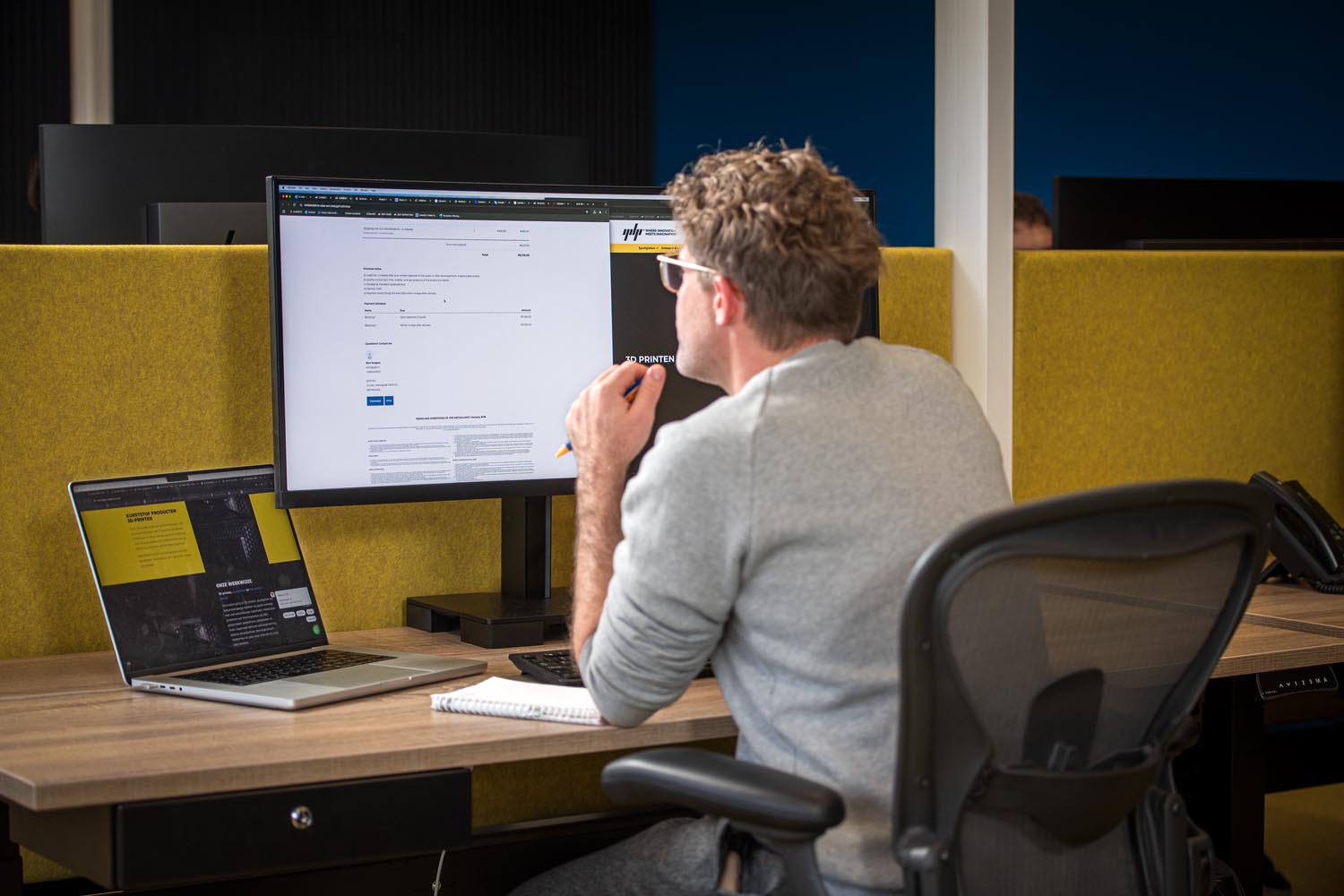
Yes. With the online calculator you’ll get an immediate indication of your unit and mold price. If you want a substantiated quote, send your CAD file or drawing. QDP then provides a price and advice about manufacturability.
I have a 3D print prototype. Can you scale that up?+
Yes. Many customers come with a functional prototype. Our role starts with production-ready preparation for injection molding: draft angles, wall thickness, material behavior, and manufacturability, so the prototype becomes a reliable series.
QDP produces in China. Is that reliable?+
Yes, because QDP does it itself. The factory in Shengzhou was set up in 2010 and has been 100 percent owned by QDP since 2012. No middleman, no broker, no black box. Material selection, production parameters, and quality assurance are controlled internally, with QC reports and logging of injection parameters, while design, engineering and QC are in the Netherlands with a dedicated point of contact. That is one of the reasons customers stay for more than ten years.
How do I know my product will not be copied?+
A valid question that QDP takes seriously. The Chinese factory is 100 percent owned by QDP, so nothing is outsourced to third parties who could run off with your drawings. CAD files and revisions are on protected environments with access for those involved only, and we routinely use NDAs. If you bring your own design, the contract establishes that intellectual property remains yours. In almost twenty years of Chinese production, QDP has established clear processes for this.
How quickly will I get an answer?+
To a message via the form or by e-mail, we usually reply within one working day. For a quote or technical question, the answer comes from an engineer or project leader, not a general helpdesk. At QDP you have a dedicated contact familiar with your project.
Can I come by for a meeting?+
Yes. We’re happy to do an introduction or brainstorm on site in Duiven or online, whichever suits you best. Bring your drawing or idea, and we’ll immediately think along about manufacturability.
In which languages can I contact you?+
Dutch, English, German, and Spanish. We work for product companies and OEMs in the Netherlands, Belgium, Germany, and Spain, and switch to whichever language suits you. For Spanish-speaking markets, QDP has a fixed point of contact.
Which sectors does QDP serve?+
Among others Mobility, Consumer, Public, Industrial, Medical, Garden, Sustainability and Kids, with customers such as Philips, AkzoNobel, BAM, Pon and Van Raam. QDP explicitly does not work for tobacco, adult industry, recreational drugs, or Single Use Plastic productions.
Is your question not listed?
Ask an engineer directly
We prefer to answer a technical question with your drawing or idea included. Schedule a non-binding 30-minute brainstorm, or send your question using the contact form. You get an answer from an engineer, not a helpdesk.