Design for Manufacturing / Draft Angles
DfM Deep dive
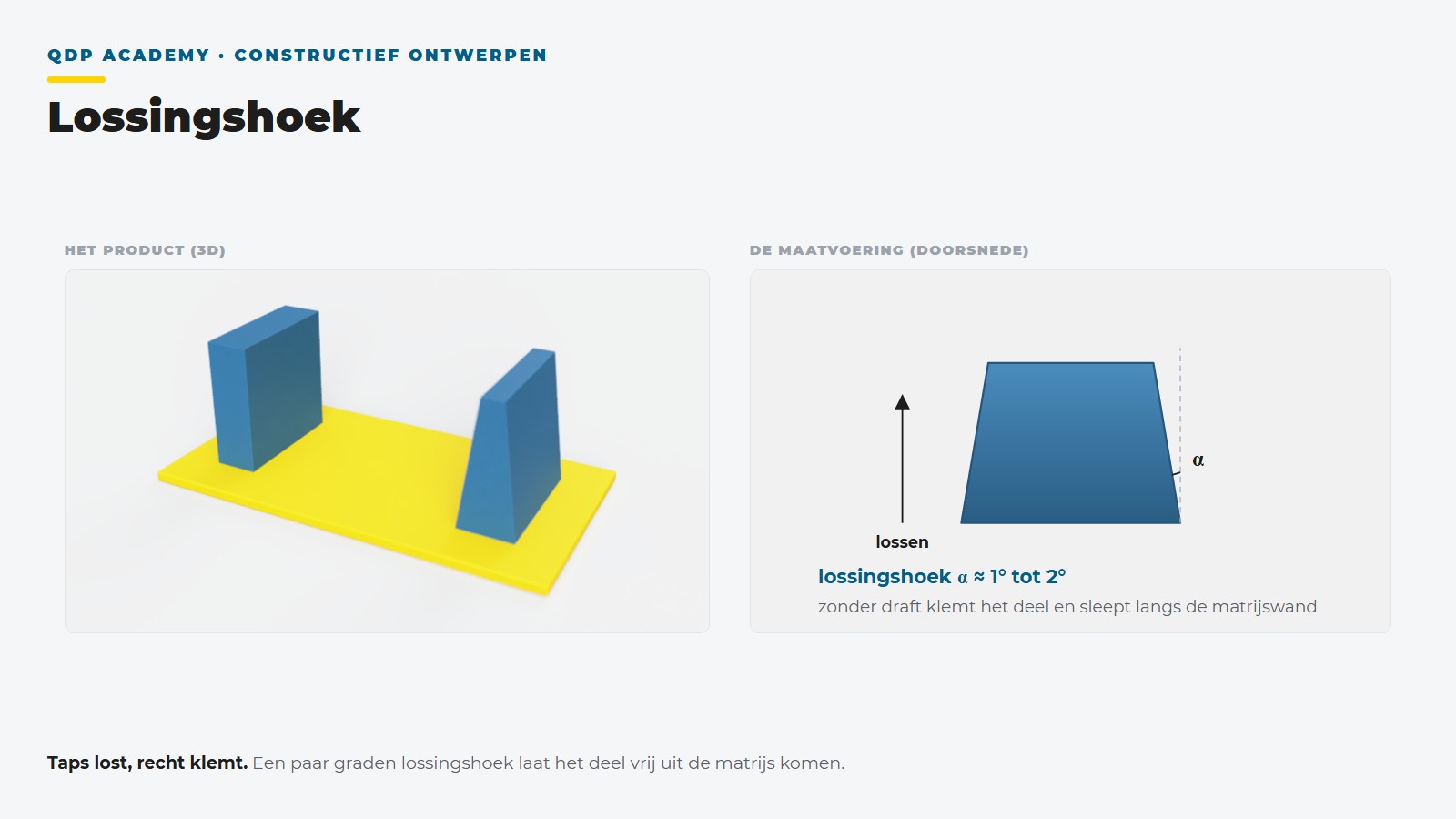
Draft angles: without draft, a product does not release cleanly from the mold
Every surface in the direction of demolding requires draft (draft angle). Without draft, the product scrapes over the mold steel upon ejection: white wear marks, high ejection forces, deformation and, over time, damaged steel.
Plastic shrinks onto the core, not away from the cavity. The core side (inside) therefore determines the ejection force and deserves the largest draft. Even small features like texts, logos, and ribs require draft on their flanks—these are often forgotten.
Indicative draft per situation
| Situation | Draft per side |
|---|---|
| Standard smooth wall | 1 to 3 degrees, design for 1.5 to 2 |
| Absolute minimum (short, smooth, polished) | 0.5 degree |
| Ribs and partitions | 0.5 to 1 degree |
| Deep boxes and sleeves (core side) | 2 to 3 degrees, plus consider venting |
| Fine etched texture | plus 1 degree extra |
| Coarse grain or leather texture | plus 1.5 to 2 degrees extra |
Indicative; the mold maker calculates the definitive draft for each face.
Draft changes dimensions
A wall of 50 mm high with 2 degrees of draft tapers 1.75 mm in thickness. So determine early which dimension is leading (top, bottom, or middle) and communicate that explicitly on the drawing. This avoids later discussions about which dimension is the 'real' one.
Draft works closely with wall thickness and material choice: see the full DfM-pillar or go to wall thickness.
What does this mean for your design?
Calculate your mold and unit price in 2 minutes, or ask our engineers for a DfM check.