Design for Manufacturing / Wall Thickness
DfM deep dive
Wall thickness: the most important choice in any injection molding design
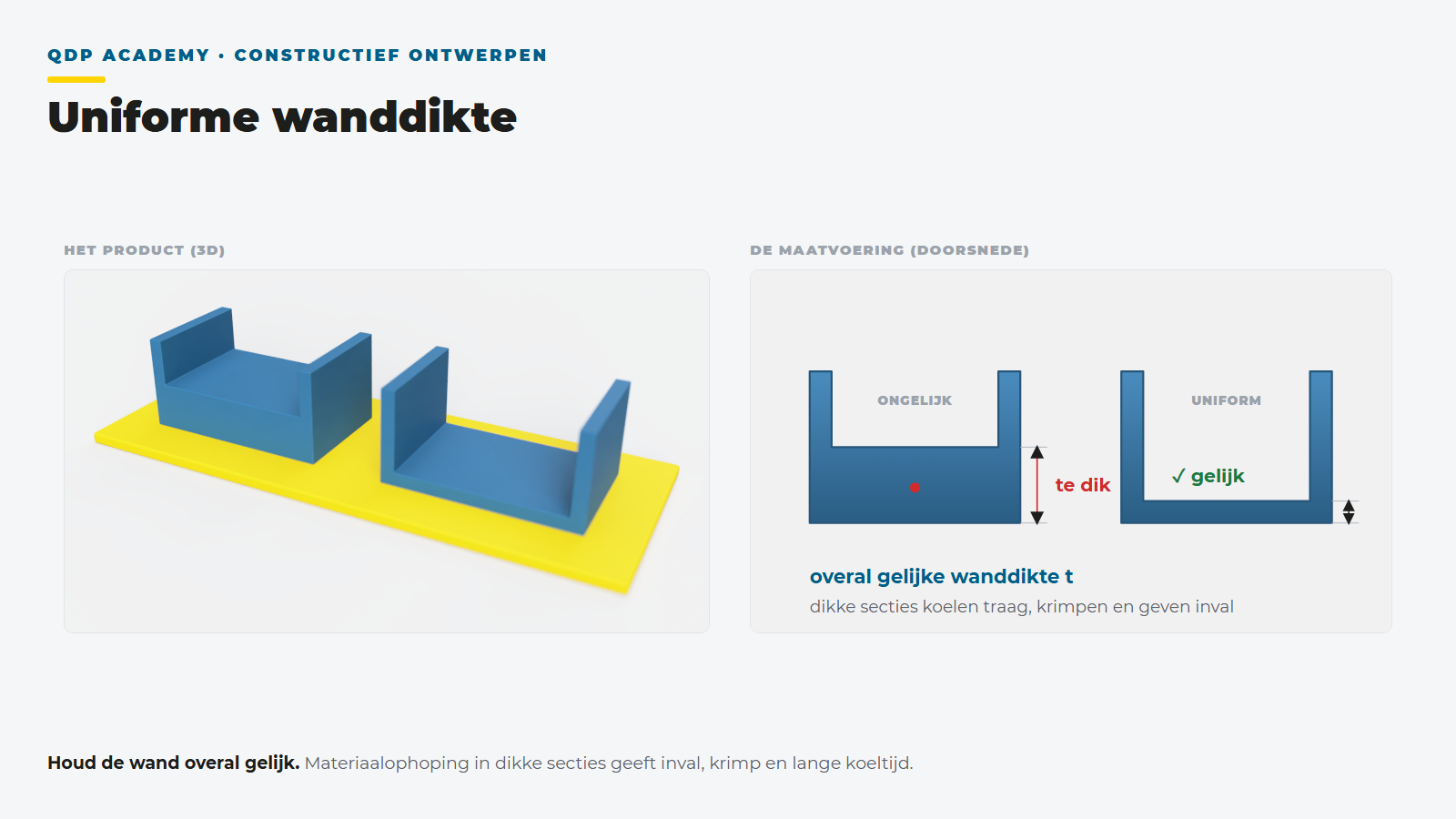
The wall thickness determines filling behavior, shrinkage, cycle time, weight, part price and quality simultaneously. Injection molding is a process of thin, uniform walls; virtually every other design rule is derived from this. An injection molded product cools from the outside in. Thick zones cool more slowly, continue shrinking for longer, and pull the product out of shape or cause sink marks on the surface.
Therefore, aim for a single nominal wall thickness throughout the entire product and solve stiffness with shape (ribs, doming, edge profiles), not with mass. Stiffness comes from geometry, not thickness.
Indicative wall thickness ranges per material
| Material | Common range | Note |
|---|---|---|
| PP | 0.8 to 3.5 mm | Flows excellently, can be locally thinner (film hinge) |
| ABS | 1.2 to 3.5 mm | All-rounder, predictably good |
| PC | 1.0 to 3.8 mm | Tough but viscous, thin long flow paths are difficult |
| PA6 (unfilled) | 0.8 to 3.0 mm | Thin works well, watch moisture absorption after molding |
| PA6 GF30 | 1.0 to 3.0 mm | Anisotropic shrinkage, warpage risk with uneven walls |
| POM | 0.8 to 3.0 mm | High, predictable shrinkage; thick zones cause shrinkage cavities |
Indicative for standard grades; the achievable thickness depends on flow path, grade and mold setup.
Transitions between wall thicknesses
Sometimes a thickness difference is unavoidable, for example at a functional surface or a connection to an insert. Make the transition gradual: keep the difference within 25 percent of the nominal wall and let the transition run over a length of at least three times the thickness difference. Let the melt flow from thick to thin, not the other way around.
Eliminate any solid zone without mechanical function with a core-out: a recess from the non-visible side that brings the zone back to nominal wall thickness. This makes a solid button into a thin-walled tube, a thick foot into a ribbed shell.
Wall thickness works together with ribs, corners and draft: see the full DfM pillar or go directly to ribs and stiffeners.
What does this mean for your design?
Calculate your mold and part price in 2 minutes, or ask our engineers for a DfM check.