Design for Manufacturing / Tolerances
DfM Deep Dive
Tolerances: as precise as necessary, not as precise as possible
An injection molded product never achieves the tolerances of a machined metal part, nor does it have to. With injection molding, the dimension is created indirectly: we inject molten plastic at 200 to 300 degrees into a mold cavity, and the product only gets its final dimension after cooling, ejection, and post-shrinkage. The product's dimension is therefore the dimension of the mold cavity minus the shrinkage, and that shrinkage is not a constant but a process variable with variation, typically between 0.4 and 2.5 percent.
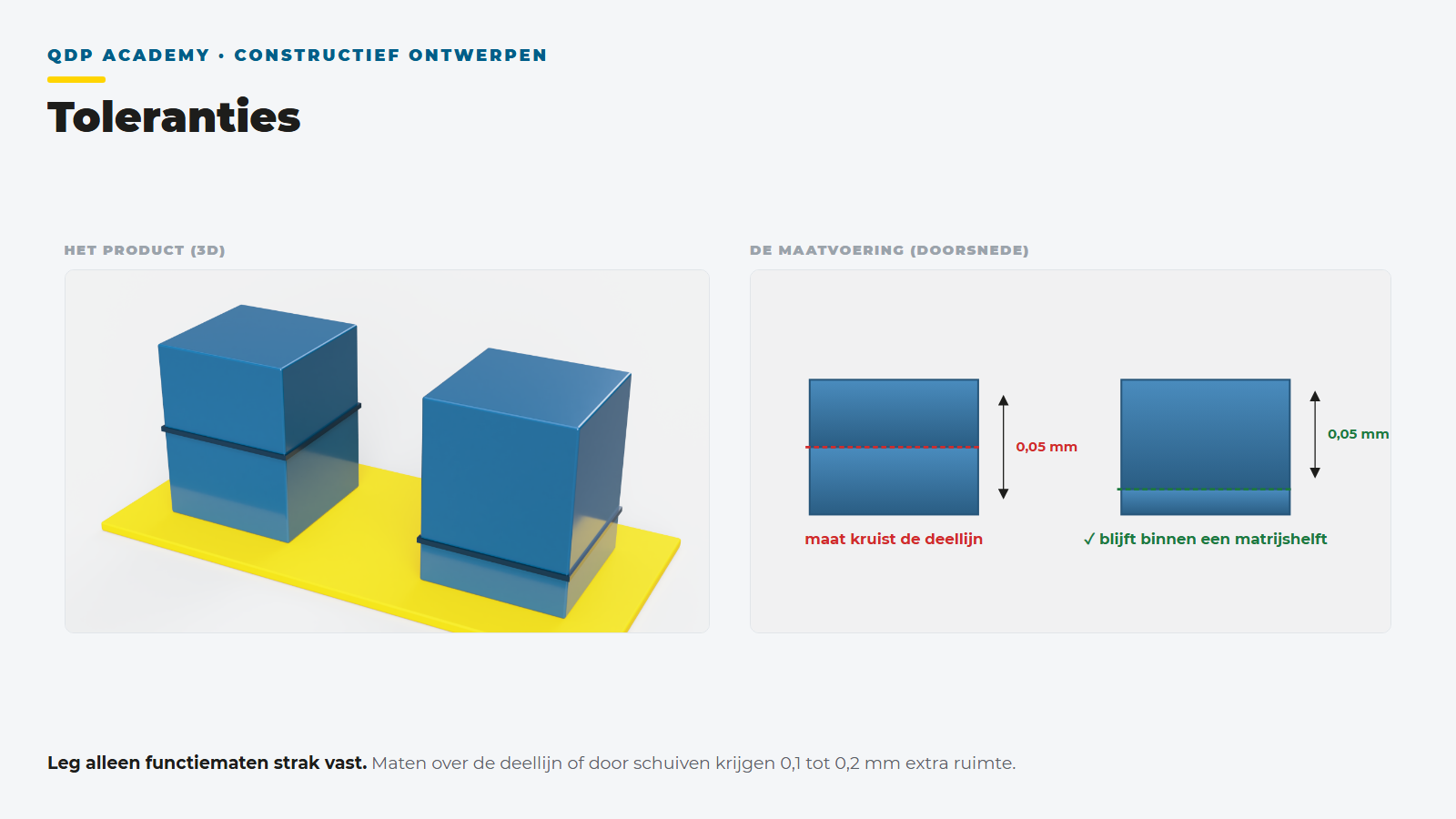
Mold-bound versus non-mold-bound dimensions
Mold-bound dimensions lie entirely within one part of the mold: both boundary surfaces are formed by the same piece of steel. Non-mold-bound dimensions cross the parting line or go through moving parts such as slides and ejectors, and also depend on how exactly the mold closes. For this latter category, allow for 0.1 to 0.2 mm extra tolerance on top of the mold-bound value.
QDP indication table per size range
| Size range | Standard | Precise (functional dimension) | Highest feasibility |
|---|---|---|---|
| up to 10 mm | ± 0.10 mm | ± 0.05 mm | ± 0.02 to 0.03 mm |
| 10 to 25 mm | ± 0.15 mm | ± 0.08 mm | ± 0.04 mm |
| 25 to 63 mm | ± 0.25 mm | ± 0.12 mm | ± 0.06 mm |
| 63 to 160 mm | ± 0.40 mm | ± 0.20 mm | ± 0.10 mm |
| 160 to 400 mm | ± 0.80 mm | ± 0.40 mm | ± 0.20 mm |
Own QDP indication for initial estimates, no standard values and no contractual commitments. Assumptions: mold-bound dimensions, favorable material, uniform wall thickness, measurement at 23 degrees after post-shrinkage. For the exact standard tables: ISO 20457 via NEN.
Only the functional dimension tight
The most important tolerance decision is which dimensions are not important. A handful of functional dimensions (fits, snap connections, sealing surfaces) receive precision tolerance with a clearly identifiable functional reason; all others fall under the general tolerance of the material group. Every tolerance without a functional reason is pure cost: it enforces measurement, mold precision, and process monitoring for a dimension that no one needs.
Tolerance and cost are not linearly related but exponentially: every halving of the tolerance does not just double the price, but does more than that, due to extra correction loops in the mold and a smaller process window.
See the full DfM-pillar or go to material selection.
What does this mean for your design?
Calculate your mold and unit price in 2 minutes, or ask our engineers for a DfM check.