Design for Manufacturing / Weld Lines
DfM Deep Dive
Weld Lines: where the flow front meets again
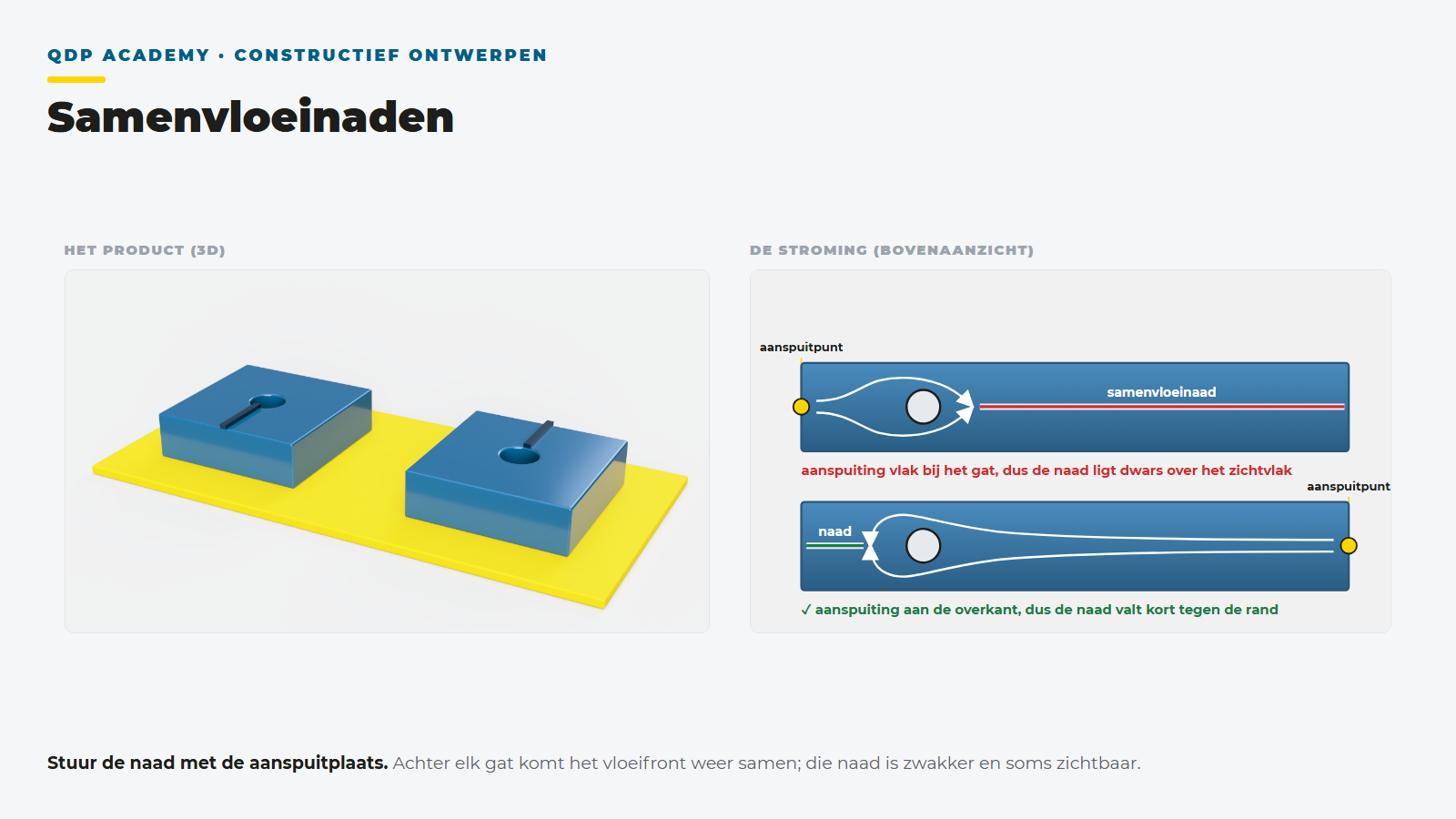
Where two melt fronts meet, a weld line forms. This happens behind every hole, behind every core, at every multiple gate, and everywhere the flow splits and rejoins. The fronts never merge perfectly: the molecules are aligned along the seam instead of through it, and that costs strength.
Strength loss at the weld line (indicative)
| Material | Residual strength vs. base material |
|---|---|
| PP, PE (unfilled) | 85 to 100% |
| ABS, PC, PC/ABS | 80 to 95% |
| PA unfilled | 80 to 95% |
| Glass-filled grades (e.g. PA6 GF30) | 40 to 60% |
| Talc-/mineral-filled | 60 to 80% |
With fiber-filled materials, the loss is greatest: the fibers do not cross the seam, so at the seam you are actually relying on the matrix strength.
Visibility
On visible surfaces, a seam stands out as a fine line or difference in gloss, most apparent with dark high-gloss colors and metallics. Texture and matte surfaces partially hide seams.
Steer instead of hope
- Choose gate position so that the seam falls in a non-critical area, not at the most highly loaded cross-section and not in the middle of the visible surface.
- Wall thickness as a control: the melt follows the thickest path. A locally slightly thicker flow leader pulls the front toward it, a thinner zone slows it down.
- Increase seam quality by letting the seam form while both fronts are still hot, with venting or an overflow tab at the seam position.
View the full DfM pillar or go to gating and mold flow.
What does this mean for your design?
Calculate your mold and unit price in 2 minutes, or ask our engineers for a DfM check.